The Capital Risk Intelligence Brief
The diagnostic layer that arrives before the commitment — not after the consequences.
For 18 years, the Procurement Insights archive has documented the patterns that determine whether technology investments succeed or fail. The CFO has always been central to those outcomes — approving the capital, absorbing the variance when ROI does not materialize, and signing off on post-mortems that consistently land on the wrong function.
Every post in this section speaks to capital allocation risk, working capital exposure under disruption conditions, and what independent validation looks like before a commitment is made rather than after the consequences arrive. The archive contains 3,300+ published documents, zero vendor sponsorships, and zero paid analyst relationships. The research was always relevant to your decisions. It is now presented directly to the audience with the budget authority to act on it.
The cost of the governance gap is not theoretical. It has been documented across 18 years and seven technology eras. The question is whether it gets diagnosed before the commitment or after the consequences.
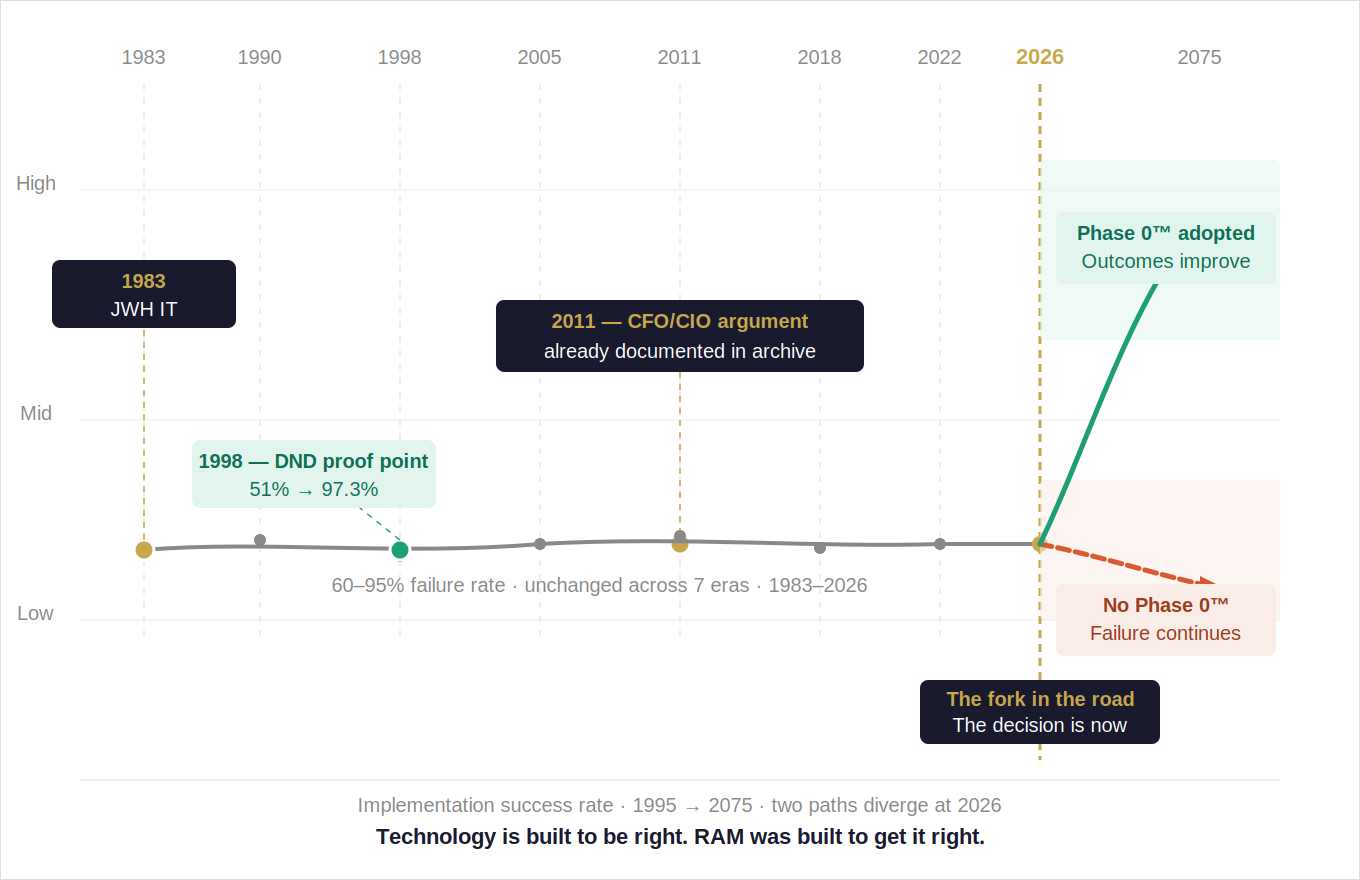
The Procurement Insights archive is grounded in a SR&ED-funded 1998 initiative at Canada’s Department of National Defence that produced delivery performance improvement from 51% to 97.3% in 90 days — sustained for seven consecutive years — with a 23% annual cost reduction. The diagnostic work that produced those outcomes preceded the technology deployment. That sequence is the foundation of everything that follows.
Posts in This Section
We Have Been Calling Them Procurement Failures. They Are Not. Here Is How CIOs and CFOs Can Own This Before the Next One.
The 60 to 85 percent technology implementation failure rate has held across seven technology eras. The post-mortem consistently lands on procurement. But the capital decision sat with finance. The architecture decision sat with IT. The organizational conditions that determined whether the implementation could succeed or fail were established before procurement was handed the project. This post names who owns the gap — and what the CFO can do before the next commitment is made rather than after the variance is reported.
When the Strait Closes: Supply Chain Intelligence for Organizations With Iran Exposure
The Hormuz disruption and tariff compounding are creating dual-crisis conditions that working capital models were not designed to absorb simultaneously. This intelligence paper documents the supply chain exposure profile for organizations with direct or indirect Iran/Gulf region dependencies — and identifies the capital allocation decisions that need to be made before the window closes rather than after the disruption is active.
The Hansen Models™ nine-brief Iran War Exposure Assessment series provides the intelligence layer that sits between public news and internal risk modeling. This is not forecast. It is operational intelligence grounded in 18 years of supply chain pattern documentation.
→ Access the When the Strait Closes intelligence paper — $2,500
→ Download the Enterprise Justification Memo — Free
The Gartner Quick Wins Framework: What the Evidence Shows — and What It Doesn’t
Gartner’s 6.7 versus 8.9 months claim is proprietary research used to market their Executive FastStart™ product. The methodology, sample size, and definition of success are not disclosed. The independent research that does exist — including the 2009 Harvard Business Review study of 5,400 new leaders — found that over-focus on quick wins causes executives to lose sight of overall goals and generate bigger losses downstream. For a CFO approving capital against a 90-day initiative timeline, this post raises the three questions that should precede that approval.
The Five-Figure Question: What Independent Vendor Assessment Costs Versus What Gartner Charges
The CFO approving a technology investment deserves to know whether the analyst report that justified the recommendation was produced independently or within a vendor-aligned commercial relationship. This post documents the cost differential between Gartner’s Magic Quadrant access and the Hansen Fit Score™ independent assessment — and what each instrument actually measures.
About the Archive
The Procurement Insights archive contains 3,300+ published documents spanning 18 years of independently produced, timestamped research. Zero vendor sponsorships. Zero paid analyst relationships. The empirical foundation is a SR&ED-funded 1998 DND initiative that achieved 97.3% delivery performance in 90 days and sustained 23% annual cost savings for seven consecutive years — because the process structural integrity and resulting governance architecture were established before the technology was deployed.
Phase 0™ is the organizational readiness diagnostic that determines whether the capital you are about to commit will produce the outcome the business case promises — or whether the process structural integrity and governance architecture gap will surface after the investment is made.
Hansen Fit Score™ provides the independent vendor assessment the Magic Quadrant does not: a longitudinal, evidence-based evaluation of whether a platform has demonstrated the behavioral alignment to perform under real-world organizational conditions.
RAM 2025™ is the multimodel validation framework that cross-validates all major Hansen Models™ assessments before publication — zero vendor sponsorships, zero paid analyst relationships.
If you are a CFO who has approved technology investments that did not produce the outcomes the business case promised — or who is about to approve one — this is the moment to establish what the independent evidence actually shows.
Book a 30-Minute Readiness Conversation with Jon Hansen — no sales pitch, just an honest conversation about where the capital risk actually sits in your current initiative portfolio.
→ Book your 30-Minute Readiness Conversation
-30-


 Procurement Insights