The Architecture Accountability Brief
When the system is confident and the organization is not ready, the CIO owns the gap.
For 18 years, the Procurement Insights archive has documented the patterns that determine whether technology investments succeed or fail. The audience for that research has always been broader than procurement. The CIO section makes that explicit.
Every post in this section speaks to governance architecture, AI platform integrity, and the question of whether the systems you are approving can sustain the decisions they are producing under real-world conditions. The archive contains 3,300+ published documents, zero vendor sponsorships, and zero paid analyst relationships. What follows is the research that was always relevant to your decisions — now presented directly to the audience with the authority to act on it.
The diagnostic question has not changed since 1998. What changes is the window available to act on the answer.
Jon Hansen has been part of IT executive communities since 1983. In 2018 he interviewed Kevin Peesker, then President of Microsoft Canada, at the Activate Digital Conference in Guelph on digital transformation, cultural evolution, and what genuine technology partnership looks like. He served on the advisory board for ITAC and worked with CATA. The Procurement Insights archive is the longitudinal evidence base that connects those conversations to the outcomes organizations are producing — and failing to produce — today.
Posts in This Section
The Gartner Quick Wins Framework: What the Evidence Shows — and What It Doesn’t
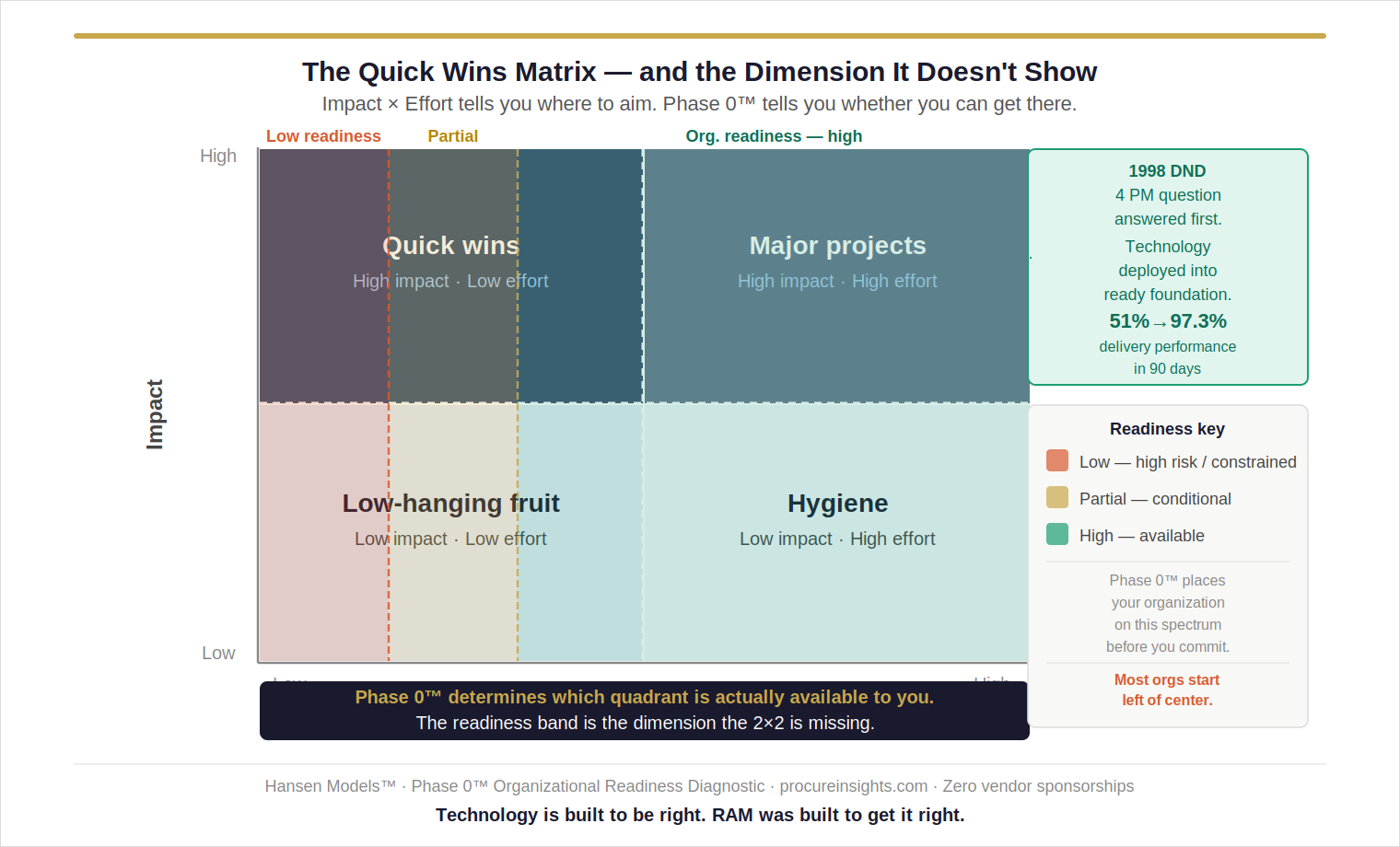
Gartner’s Project Prioritization Matrix tells new executives to identify Quick Wins within 90 days. The claim that executives with a transition plan reach success in 6.7 months versus 8.9 months without one is cited as Gartner research — but the methodology, sample size, and definition of success are not disclosed. We searched for the independent, peer-reviewed evidence. Here is exactly what we found — and what we did not find. The three questions this post raises about sustained outcomes, readiness versus speed, and matrix availability remain unanswered in any publicly available Gartner publication.
Phase 0™ is the organizational readiness diagnostic that determines which quadrant of the matrix is actually available to you — at whatever stage you are at.
The Questions IT Leaders Were Asking in 2019 Are the Same Questions We Are Still Asking in 2026. Neither Community Has the Answer It Thinks It Has.
In January 2019, IDC Canada and ITAC hosted a tech trends breakfast in Toronto focused on intelligent automation, AI, and how business and IT leaders would adapt to machines and humans working together. In 2026, procurement leaders are asking the same questions. Seven years later. With a different vendor landscape and a new generation of AI-enabled platforms — but the same structural gap between what capable technology recommends and what organizations are actually designed to do with that recommendation.
The diagnostic layer was missing in 2019. It is still missing now. And it has a name.
We Have Been Calling Them Procurement Failures. They Are Not. Here Is How CIOs and CFOs Can Own This Before the Next One.
The 60 to 85 percent technology implementation failure rate has held across seven technology eras. ERP. eProcurement. SRM. P2P. Analytics. Cloud. AI. The post-mortem consistently lands on procurement. But the capital decision sat with finance. The architecture decision sat with IT. The organizational conditions that determined whether the implementation could succeed or fail were established before procurement was handed the implementation. This post names who owns the gap — and what changes when they own it.
ProcureTech Providers and Analysts Are Recommending the Wrong AI Model. Here Is What Procurement Practitioners Are Not Being Told.
The Mixture of Experts architecture inside today’s leading AI platforms is built for closed-frame optimization — finding the best answer within a defined solution space. RAM 2025™ is built for open-frame epistemic validation — cross-validating outputs across multiple models to surface what a single model cannot see. This post explains why the AI model the procurement and IT communities are being sold is the wrong instrument for the governance problem they are actually trying to solve.
About the Archive
The Procurement Insights archive contains 3,300+ published documents spanning 18 years of independently produced, timestamped research. Zero vendor sponsorships. Zero paid analyst relationships. The SR&ED-funded 1998 Department of National Defence initiative — which produced delivery performance improvement from 51% to 97.3% in 90 days, sustained for seven consecutive years — is the empirical foundation for everything that follows.
Phase 0™ is the organizational readiness diagnostic that precedes all technology and initiative commitments — before the decision is made, during implementation, or when current performance is not meeting expectations.
Hansen Fit Score™ identifies the conditions under which outcomes have consistently succeeded or failed across 18 years and seven technology eras.
RAM 2025™ is the multimodel validation framework that cross-validates all major Hansen Models™ assessments before publication.
Ready to determine whether your current initiative is in the right quadrant — or whether the process structural integrity and resulting governance architecture can sustain what you are about to commit to?
Book a 30-Minute Readiness Conversation with Jon Hansen — no sales pitch, just an honest diagnostic discussion about where your organization sits on the readiness spectrum.
→ Book your 30-Minute Readiness Conversation
-30-


 Procurement Insights