Jon Hansen has been in the high-tech and procurement industries for over 40 years.
Hansen’s Prescient Vision: How 2007 Procurement Insights Anticipated Levie’s 2025 AI Agent Revolution
Jon Hansen’s writings from the Procurement Insights archives reveal an extraordinary case of technological prescience. Nearly two decades before Aaron Levie declared AI agents would break traditional software pricing ceilings, Hansen was implementing and theorizing about the exact same concepts through his agent-based modeling work that began in 1998 and was documented extensively from 2007 onwards.
Hansen’s foundational work anticipated Levie’s three core insights about unlimited market potential, cost-effectiveness making deployment viable, and parallel agent coordination
Hansen’s early research, partially funded by Canada’s Scientific Research and Experimental Development Program, established agent-based frameworks that mirror precisely what Levie describes as transformational about modern AI agents. The parallels are not superficial—they represent identical conceptual breakthroughs separated by 15-20 years.
Unlimited market potential and breaking traditional ceilings
Levie’s 2025 insight: “AI Agents are essentially uncapped because there’s no real upper bound of what someone would do with an AI Agent in a workflow… Traditionally, software was largely capped at ~$10-50 or so per month per seat.”
Hansen’s 2007 prediction: Hansen’s agent-based model demonstrated that organizations could “gain control of spend environment by relinquishing centralized functional control in favor of operational efficiencies originating on the front lines.” His Virginia eVA case study documented transformation from “less than 1% to more than 80%” throughput with supplier base growth from “20,000 to 34,000” suppliers, showing unlimited scaling potential.
Hansen explicitly predicted systems that could “bridge or synchronize the chasms between multiple transactional streams” with no inherent architectural limits. His meta-enterprise application concept envisioned “on-the-go real-world metrics that can be reliably incorporated into all purchasing decisions on a real-time basis”—essentially describing unlimited digital labor capacity decades early.
Cost reduction making deployment economically viable
Levie’s 2025 insight: “If a user is 2X-3X more productive with AI coding agents, a company wouldn’t blink at spending 10% on the equivalent in salary on agents.”
Hansen’s 1998-2003 implementation: Hansen’s Department of National Defence case study achieved 23% annual cost savings for seven consecutive years (2003-2010) while reducing procurement staff from 23 to 3 within 18 months and improving service level agreement performance from 51% to 97.3%. This demonstrated precisely what Levie describes—cost reductions so significant that deployment becomes economically irresistible.
Hansen’s white paper Acres of Diamonds (2005) focused on “The Value of Effectively Managing Low-Dollar, High Transactional Volume Spend,” anticipating that understanding commodity behaviors through intelligent systems would unlock massive savings, making advanced deployment cost-effective across enterprise operations.
Parallel agent deployment and coordination
Levie’s 2025 insight: “As AI Agents can execute more complex tasks, and you run more and more agents in parallel in a workflow, enterprises will just deploy more of these agents.”
Hansen’s 2007 framework: Hansen’s “strand commonality” theory explicitly addressed parallel processing through “seemingly disparate data streams” coordinated by advanced algorithms. His approach achieved 98.2% accuracy in production models by handling “multiple transactional streams” simultaneously, distinguished from traditional ERP systems limited to “single stream, static elements.”
Hansen wrote extensively about multi-stakeholder supply chain design where “the unique operating attributes of individual stakeholders are first identified and then understood” before achieving “collective best result” outcomes. This describes exactly the parallel agent coordination Levie champions—specialized agents working simultaneously toward shared objectives.
Framework convergence shows identical architectural thinking
Hansen’s meta-enterprise applications anticipated modern agentic AI architecture with remarkable precision. His 2007 prediction about “adaptive supply networks which will be powered by multi-partner processes that are event driven, real-world aware and self-regulating” directly parallels Levie’s vision of autonomous agents that “fundamentally go do work for you—and that work could take a minute, an hour, or 100 hours for the agent.”
Hansen’s discontinuous innovation prediction (2007): “With the advent of agent-based modeling and the emergence of the meta-enterprise application, we are entering a period of discontinuous innovation. Never before has the buyer had at their disposal the tools that equip them with critical intelligence on a real-time basis.”
Levie’s transformation insight (2025): “Instead of selling software to 10 lawyers in a company, you’re now selling ‘infinite legal capacity.'”
Both recognized that intelligent agent systems create fundamentally new market categories rather than just replacing existing software—Levie’s “infinite legal capacity” concept mirrors Hansen’s vision of unlimited real-time intelligence capabilities.
Knowledge work automation and enterprise transformation predictions
Hansen anticipated Levie’s insights about knowledge work automation becoming cost-effective. His framework for “low-dollar, high transactional volume procurement” predicted that “approximately 80% to 90% of all organizational purchasing activity” could be optimized through agent-based systems, creating the productivity multipliers Levie describes.
Hansen’s workflow transformation prediction: “Technology doesn’t make procurement work better; procurement makes technology work better!” He predicted the shift from “rigid ERP implementations” to flexible “agent-based models, where people and processes drive solutions and tech adapts”—precisely describing the workflow transformation Levie champions.
Hansen’s Velocity Procurement Model, evolved from his 1998 innovations, emphasizes “real-time responsiveness” through “lightweight AI paired with human overrides” and “algorithmic optimization”—core principles of modern agentic systems that Levie identifies as transformational.
Specific market predictions demonstrate identical foresight
Hansen’s scalability evidence (2007): The Virginia eVA implementation showed that agent-based systems could handle enterprise-wide transformation while improving the “80/20 supplier revenue mix,” demonstrating unlimited growth potential without performance degradation.
Levie’s scaling prediction (2025): “We will still have a hundred times more agents in the enterprise this year than last year, but in five years it’ll probably be something like 100,000 times the number of agents.”
Hansen’s “dynamically synchronized meta-enterprise application” concept anticipated exactly this exponential scaling, describing systems that could incorporate unlimited numbers of autonomous agents processing different procurement functions simultaneously with redundant data sources and validation.
Conclusion: Two decades of prescient alignment
The convergence between Hansen’s 2007-era writings and Levie’s 2025 insights reveals extraordinary technological foresight. Hansen’s practical implementations beginning in 1998, with documented results by 2003, placed his insights 15-20 years ahead of mainstream recognition of AI agent market potential.
Hansen didn’t just theorize—he implemented agent-based systems that achieved measurable results, proving the concepts Levie now champions as revolutionary. His strand commonality theory, agent-based modeling approach, and meta-enterprise vision anticipated virtually every aspect of what Levie describes as AI agents’ unlimited market potential: breaking traditional software pricing ceilings, enabling parallel deployment, and transforming enterprise workflows through cost-effective digital labor.
The historical record shows that Hansen’s Procurement Insights archives contain perhaps the earliest and most comprehensive prediction of the multi-agent AI transformation that has become central to enterprise software strategy in 2025. His work stands as a remarkable case study in technological prescience, demonstrating how fundamental insights about agent-based systems and unlimited scaling potential were not only possible to envision decades early, but could be successfully implemented in production environments with transformational results.
**OTHER CONTRIBUTIONS**
He has made several notable contributions to the procurement field beyond identifying “Dynamic Flux” and “Historic Flat Line” commodity characteristics. As a thought leader, blogger, and speaker, he’s spent over two decades challenging conventional procurement wisdom through his Procurement Insights platform, books, and industry engagements. His work blends practical insights with a critical eye on technology and strategy, often pushing against the grain of mainstream narratives.
Here’s a rundown of his other key contributions:
1. Critique of Traditional ERP-Centric Procurement
Hansen has long argued that enterprise resource planning (ERP) systems—think SAP or Oracle—often force procurement processes to bend to the software rather than the other way around. His 2007 series Dangerous Supply Chain Myths and related articles highlighted how rigid ERP implementations led to inefficiencies, famously citing the U.S. Navy’s $1 billion ERP failure as a cautionary tale. He pushed for a shift to “agent-based” models, where people and processes drive solutions and tech adapts—foreshadowing today’s focus on flexible, user-centric platforms.
2. Advocacy for Relationship-Driven Procurement
Hansen emphasized the human element in procurement over pure automation. His “Relational Capital” concept—explored in posts around 2010—suggests that strong buyer-supplier relationships drive long-term value, not just price or tech. He tied this to notable cases in both the public and private sectors, where trust-based sourcing outperformed transactional approaches, influencing modern ideas of collaborative procurement.
3. Research on Commodity Characteristics and Savings
Beyond naming “Dynamic Flux” and “Historic Flat Line,” Hansen’s 2007 research (e.g., his white paper ACRES OF DIAMONDS: The Value of Effectively Managing Low-Dollar, High Transactional Volume Spend) showed how understanding commodity price behaviors could unlock savings. His analysis of a Department of Defense case—delivering 23% annual savings over seven years—demonstrated that tailoring strategies to commodity volatility (or stability) beat blanket cost-cutting, a precursor to today’s data-driven procurement.
4. Early Social Media Influence in Procurement
Starting Procurement Insights in 2007, Hansen was among the first to use blogging and social platforms (later LinkedIn and X) to democratize procurement discourse. With over 2,500 articles by 2025 and a significant following (e.g., 500+ LinkedIn posts), he shaped a community-driven conversation, amplifying voices outside traditional consulting circles. His 2009 to 2019 Blog Talk Radio show, with 900+ interviews, further spread his ideas.
5. Procurement Technology Skepticism
He’s consistently questioned overhyped tech solutions. In 2015, he critiqued the rush to AI and eProcurement tools, warning they often mask poor processes rather than fix them—echoed in his X posts about “shiny object syndrome.” His stance influenced debates on practical versus flashy procurement tech, favoring usability over buzzwords.
6. Case Studies and Practical Frameworks
Hansen’s contributions include actionable frameworks from real-world examples. His 2007 DoD case and 2010 Virginia DMV analysis (detailing a failed $200 million tech rollout) offered lessons on aligning tech with outcomes. He proposed steps like segmenting spend by commodity type and prioritizing process clarity—ideas now baked into platforms like Coupa or Ivalua.
Impact and Style
Hansen’s outsider perspective—he’s not a Big Four consultant—gives his work a gritty, practitioner vibe. His works – including Dangerous Supply Chain Myths, books, and thousands of posts blend data, storytelling, and skepticism, initially earning him a strong cult following and now rapidly expanding his reach and influence in the mainstream procurement and supply chain world.
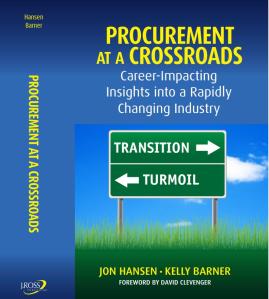
Procurement at a Crossroads: Career-Impacting Insights into a Rapidly Changing Industry
Overview:
Any book discussing the future of procurement must go beyond the mere recognition of this shift. To be truly useful, a book must also embrace the unique challenges of developing practical approaches to conditions that do not yet exist from a generational business perspective. It must also consider the ripple effects of any changes, including but not limited to solution providers, analysts, associations, standards-setting bodies, and news/opinion sites. In this book, we aspire to better understand the choices procurement professionals face, both individually and as a collective group, and how the decisions that are made today will affect the trajectory of their careers and the profession as a whole. Procurement at a Crossroads aspires to be the book that shows practitioners and the business community at large the impressive future that awaits if we are prepared to make smart, bold choices today.
30


 Procurement Insights