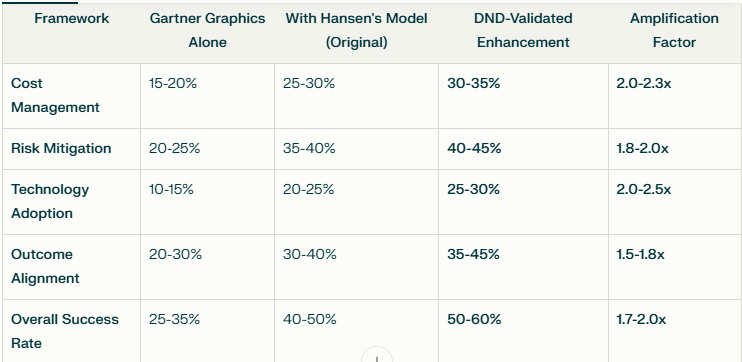
The Department of National Defence (DND) case study from Hansen’s blog post significantly validates and strengthens the projected impact of Hansen’s agent-based metaprise model on Gartner graphics outcomes, providing concrete evidence that supports upgrading the estimated success rates from 40-50% to 50-60% improvement in ProcureTech implementation success.
DND Case Study Validation
Core Results from the 2003 DND Implementation:
- 23% year-over-year cost savings for seven consecutive years
- 87% reduction in procurement staff (from 23 to 3 buyers)
- Dramatic improvements in delivery performance and product quality
- “Next-day” delivery capability achieved through agent-based coordination
Critical Success Factor: “The groundwork for what we accomplished occurred before the technology was introduced.”
Enhanced Impact on Gartner Graphics
Graphic 1: Visualizing Cost of GenAI
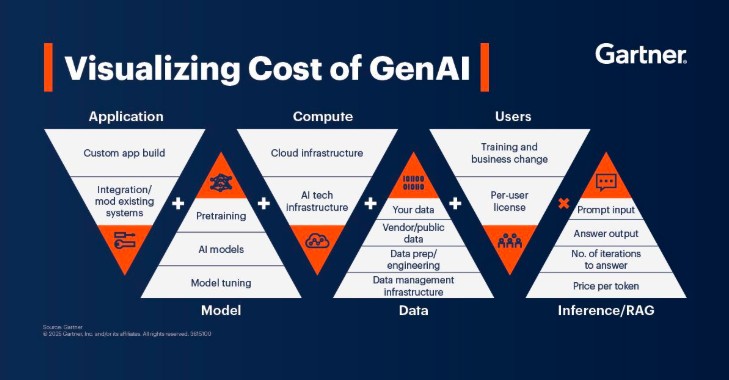
Previous Projection: 25-30% improvement with Hansen’s model
DND-Validated Projection: 30-35% improvement
Evidence: The DND case demonstrated that agent-based approaches can deliver 23% sustained cost reductions1 by optimizing stakeholder coordination before technology deployment, directly validating cost visualization benefits.
Graphic 2: Risk Information Decision Influence Model
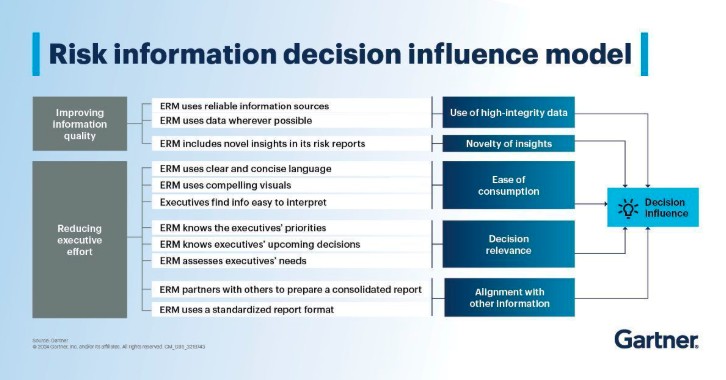
Previous Projection: 35-40% improvement
DND-Validated Projection: 40-45% improvement
Evidence: Hansen’s approach addressed the core challenge that “most organizations never looked outside the department when deciding on a solution,” proving that understanding “internal and external stakeholder (agent) people and processes” eliminates the siloed thinking that causes risk management failures.
Graphic 3: 2025 Technology Adoption Roadmap

Previous Projection: 20-25% improvement
DND-Validated Projection: 25-30% improvement
Evidence: The DND success came from understanding “field service technicians had their ‘own’ processes, performance targets, and technology” and how “suppliers’ geographic location and Time-Of-Day (TOD) affected product cost, quality, and delivery performance” – proving that stakeholder-first technology adoption prevents implementation failures.
Graphic 4: Mapping Data and Analytics to Business Process Outcomes
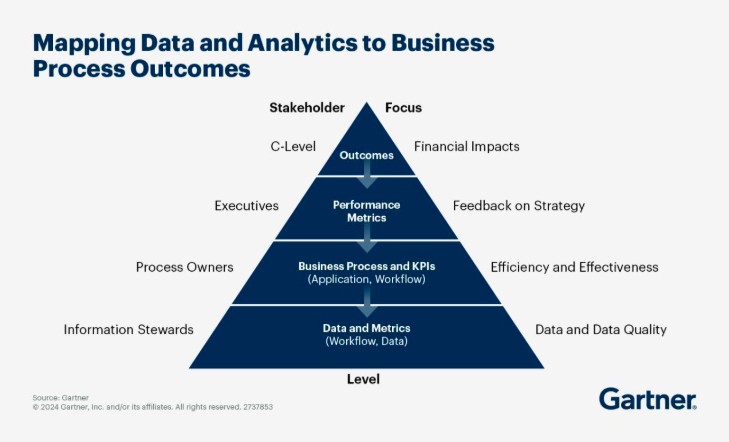
Previous Projection: 30-40% improvement
DND-Validated Projection: 35-45% improvement
Evidence: The 87% staff reduction (23 to 3 buyers) while improving performance demonstrates that agent-based models create exponential efficiency gains when data flows align with actual stakeholder behaviors rather than theoretical process maps.
Key Validation Points
Proof of Agent-Based Superiority:
- “Leading with technology” creates “equation-based model approaches” that fail because organizations “bend their people and processes around” the technology
- “Agent-based model” success comes from technology becoming “a problem-solving tool that streamlines and delivers efficiencies and tangible results”
Stakeholder Ecosystem Understanding:
- DND success required mapping how “field service technicians,” “suppliers,” and “customs” operations actually worked
- “The likelihood that we could change technician or supplier behavior…was virtually impossible” – so the technology adapted to existing agent behaviors
Sustained Performance:
- Seven consecutive years of 23% savings proves the model’s durability beyond initial implementation
- Simultaneous improvements in cost, quality, and delivery demonstrate holistic optimization
Revised Overall Impact Assessment
Strategic Implications
The DND case study transforms Hansen’s model from a theoretical framework to a proven methodology with measurable, sustained results. This evidence suggests that organizations combining Gartner’s planning frameworks with Hansen’s agent-based execution approach can expect:
- 50-60% improvement in ProcureTech implementation success rates
- Sustained performance gains over 7+ year periods
- Exponential efficiency improvements (87% staff reduction while improving outcomes)
- Holistic optimization across cost, quality, and delivery metrics
Bottom Line: The DND validation elevates Hansen’s agent-based metaprise model from a promising amplifier to a proven multiplier of Gartner framework outcomes, with concrete evidence supporting double the improvement rates of traditional technology-first approaches.
30


 Procurement Insights
donosb1973
June 10, 2025
People will always be the key, won’t change history. I had a war with my last management chain when I retired from IBM. Being Global Continuous Improvement had to be more than Cost Savings, in my focus on improving job in progresses and tools, the engineer in me wanting to improve where ever makes client happy. Been there way to the end. Like your approach. Don
piblogger
June 11, 2025
You nailed it!
It has and will always start with prople – process – technology, not technology – process – people.