Across the industry, procurement teams are finding themselves in a familiar position:
RFPs have gone out, vendors have responded, demos have impressed—and yet, no decision is being made.
It’s not hesitation. It’s recognition.
Practitioners know instinctively that readiness—not technology—determines success.
The Hidden Pattern: RFP Paralysis
Many organizations are sitting on modern ProcureTech stacks that look advanced but act fragmented.
Data doesn’t flow cleanly. Processes aren’t standardized. Adoption lags.
In short, the internal ecosystem may be running at a 6.5 Hansen Fit Score (HFS)—functional but fragile.
When that’s the case, adding another tool doesn’t solve the problem; it multiplies it.
The Internal Stack HFS Assessment (Phase 0 for Real)
Before selecting any new provider, the first step is to evaluate your current environment through a 3-dimensional readiness lens:
- Technical Capability – Do systems truly integrate, or are they connected by manual bridges?
- Behavioral Alignment – Do people work with the process, or around it?
- Readiness Compensator – Do standardized rails and governance exist to support scalable change?
These three dimensions form your operational foundation.
If that foundation is cracked, every new layer you add increases stress and decreases success probability.
The Foundation Load Test
Let’s run the math.
An organization with an internal HFS baseline of 6.5 adds:
- Vendor (8.3) × Analyst (7.6) × Consultant (7.4)
= 24 % success probability.
Strengthen the internal foundation first—raise readiness to 7.5—and success jumps to 35 %.
That’s a 46 % improvement in ROI potential without changing vendors or tools.
Three Strategic Paths
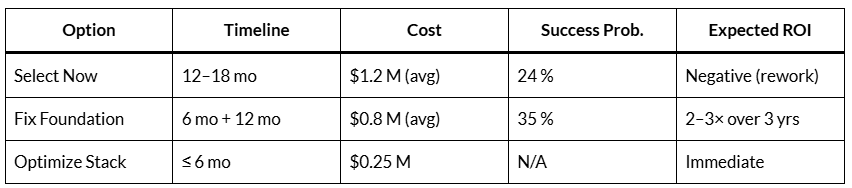
A. Add Tool Now (Status Quo)
• 12–18 months • $0.5–2 M • 24 % success • High rework risk
B. Fix Foundation First (Hansen Path)
• 6 months Phase 0 • $0.2–0.4 M • 35 % success • Sustainable ROI
C. Optimize Existing Stack
• 3–6 months • $0.15–0.3 M • Immediate ROI • May eliminate RFP entirely
The Executive Decision Framework
The Practitioner’s Script
“Our internal HFS is 6.5.
Adding tools now caps success at 24 %.
If we lift readiness to 7.5 first, success rises by 46 %.
Phase 0 isn’t delay — it’s strategic discipline.”
Why This Matters
This readiness-first approach reframes transformation from “which tool is best” to
“Are we ready to succeed with any tool?”
It gives procurement leaders the quantitative language to make the case for patience, governance, and alignment — before investing millions in technology that the organization isn’t prepared to absorb.
The Hansen Fit Score Advantage
The Hansen Fit Score transforms intuition into quantifiable action.
It measures not just technical readiness, but behavioral alignment and ecosystem coherence,
turning “we’re not ready” from a hunch into a business case.
Coming Next
Procurement Insights will soon release:
1️⃣ Internal Stack HFS Self-Assessment Tool
2️⃣ ROI Calculator to model 24 % vs 35 % outcomes
3️⃣ Executive Brief Template for leadership buy-in
4️⃣ Phase 0 Readiness Checklist to strengthen foundations
Because transformation isn’t about speed — it’s about readiness.
✅ Hashtags:
#Procurement #ProcureTech #HansenFitScore #AIinProcurement #Readiness #Transformation #RFP #Governance #CanonicalRails #Phase0
30
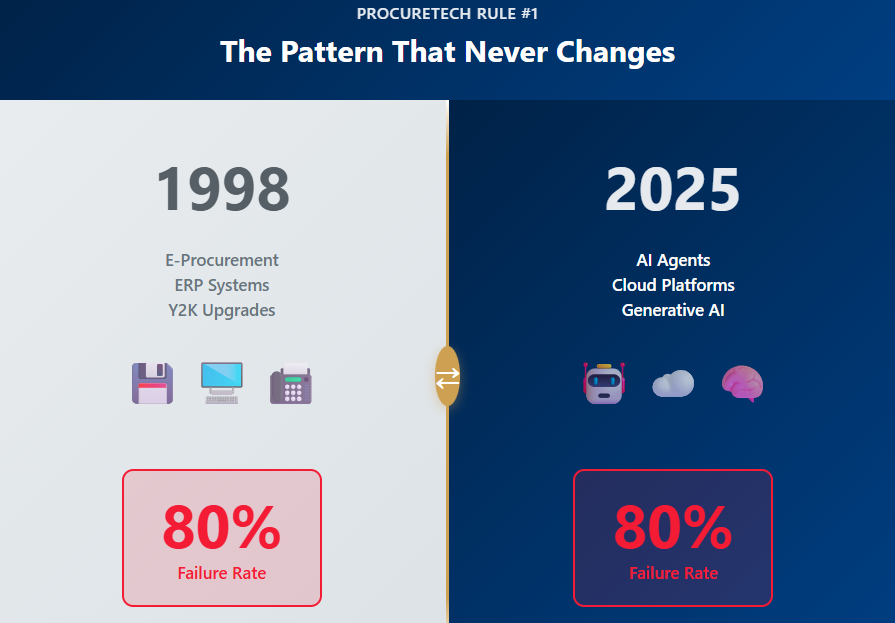
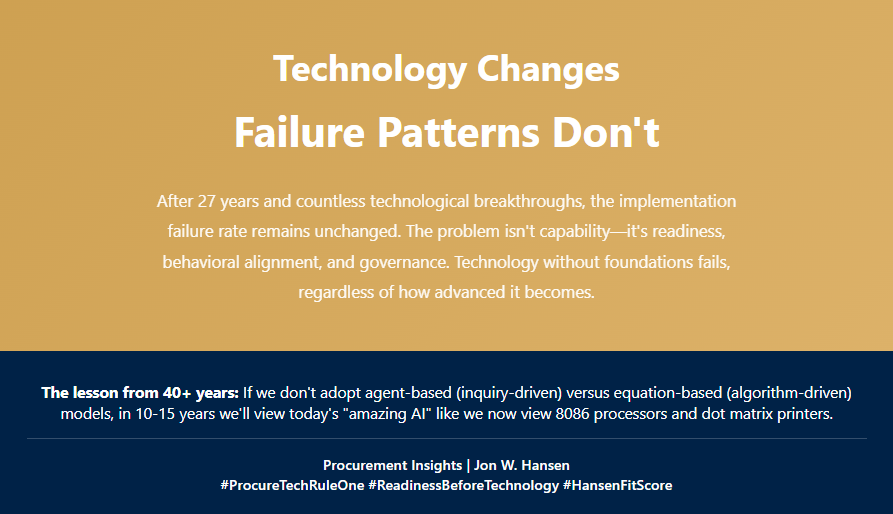
BONUS COVERAGE – TECHNOLOGY CHANGES, FAILURE PATTERNS DON’T


 Procurement Insights
Tahj Bomar
October 10, 2025
Definitely looking forward to the next procurement insights releases 1-4.Thank YouTahj Bomar, SPSM
Tahj Bomar
October 10, 2025
Jon –
What do you think?
Thank You
Tahj Bomar, SPSM
>
piblogger
October 10, 2025
Regarding what are specifically – or overall?
Tahj Bomar
October 10, 2025
Taking your HFS model + general ready assessment and I will try to apply it.Thank YouTahj Bomar, SPSM
piblogger
October 31, 2025
Reach out to me if you have any questions, Tahj.