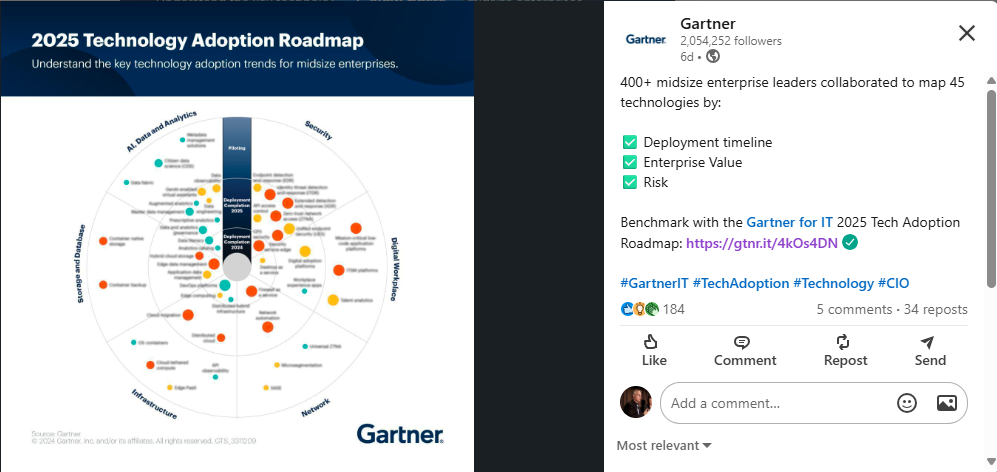
Below is a screenshot of a recent Gathner post and graphic. You can access it through the following link.
Here is a Zoom In of the Graphic above.
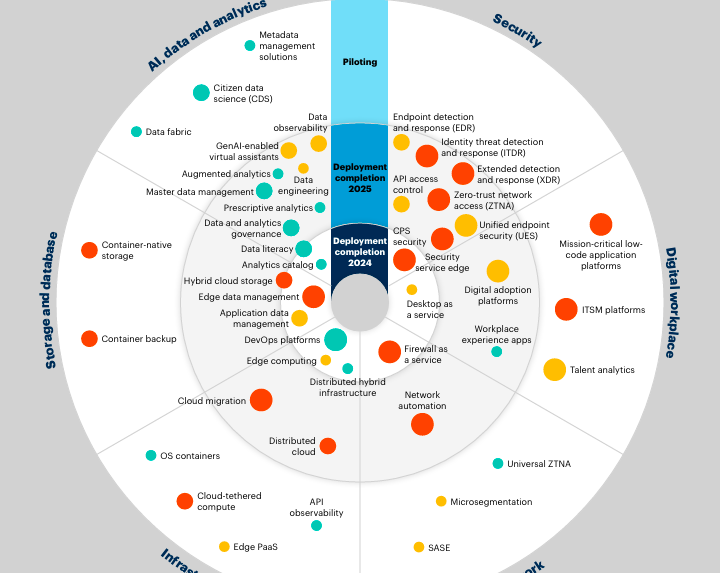
While I encourage you to use the provided Gartner link to download and access the 2-page PDF, is the download even warranted? In short, what do you hope to get from it beyond high-level, industry-wide generalizations?
Hansen’s Fit Score, Metaprise, Agent-Based, and Strand Commonality Models: Enhancing Research
The linked article from Procurement Insights (https://procureinsights.com/2025/06/27/how-does-hansens-fit-score-metaprise-agent-based-strand-commonality-models-make-gartner-mckinsey-deloitte-and-the-hackett-groups-information-and-research-better/) explains how Jon Hansen’s Fit Score, Metaprise, Agent-based, and Strand Commonality models improve the research of Gartner, McKinsey, Deloitte, and The Hackett Group. These models address limitations in traditional research by enhancing implementation speed, ROI, and adaptability, particularly in procurement and technology adoption.
Role and Insights of Hansen’s Models
- Hansen Fit Score:
- Definition: The Hansen Fit Score is an advanced AI algorithm framework (used in RAM 2025 Levels 1 and 2) that assesses technology providers based on criteria like alignment with organizational context, leadership profiles, and strategic risk management. For example, it identified SAP Ariba as the optimal choice for Duke Energy due to low implementation risk and high value delivery.
- Enhancement: Unlike Gartner’s broad suitability assessments, the Fit Score provides granular, organization-specific evaluations, integrating human factors (e.g., leadership profiles) with technical fit. This complements Gartner’s roadmap by offering MSEs a more precise tool to select providers, reducing adoption risks. For instance, it aligns technologies like DevOps or UES with specific MSE needs, enhancing the roadmap’s prioritization framework.
- Metaprise Model:
- Definition: The Metaprise model is a human-AI coordination framework that streamlines workflows and fosters multi-stakeholder collaboration, reducing implementation times by 30–50% compared to traditional approaches. It achieves this through improved taxonomy alignment and bottleneck elimination, as seen in the Canadian Department of National Defence’s rapid transformation.
- Enhancement: The Metaprise model addresses Gartner’s lack of detailed implementation guidance by providing a practical framework for executing roadmap recommendations. For MSEs adopting cloud infrastructure or analytics, it accelerates deployment (e.g., from multi-year to months), ensuring faster realization of benefits like cost efficiency or agility.
- Agent-Based Modeling (ABM):
- Definition: ABMs identify unique operating attributes in complex data streams, enabling effective use of AI and generative AI in procurement. They capture system-wide effects from autonomous agent interactions, unlike equation-based models.
- Enhancement: ABMs enhance Gartner’s roadmap by providing deeper process analysis for technologies like generative AI or data observability. They identify common patterns across MSE processes, ensuring AI-ready infrastructure aligns with operational realities, thus shortening the “hype to realization” timeline for technologies like prescriptive analytics.
- Strand Commonality Models:
- Definition: These models identify common sequences across seemingly unrelated processes, enabling optimization across organizational boundaries. They align with Gartner’s Business-Outcome-Aligned model, which emphasizes shared digital foundations.
- Enhancement: Strand Commonality models complement Gartner’s roadmap by identifying cross-functional opportunities for technologies like DAPs or edge computing, ensuring they support multiple MSE product lines. This enhances the roadmap’s strategic alignment with dynamic, adaptive enterprise needs.
How Hansen’s Models Improve Gartner, McKinsey, Deloitte, and The Hackett Group
- Faster Implementation: The Metaprise model’s 30–50% reduction in implementation time addresses a key shortcoming of Gartner’s roadmap—its lack of granular implementation guidance. This also improves McKinsey and Deloitte’s strategic frameworks by providing actionable execution paths.
- Higher ROI: Organizations using Hansen’s models achieve 30–50% faster ROI and 15–25% cost savings compared to industry averages, enhancing the cost-efficiency focus of Gartner’s analytics and cloud recommendations. This adds measurable value to The Hackett Group’s spend management insights.
- Sustained Savings: Hansen’s models deliver 23% year-over-year cost-of-goods savings, as seen in public sector cases, providing a longer-term perspective than Gartner’s 2–5-year UES benefit horizon.
- Human-Centric Focus: By integrating human factors (e.g., leadership profiles in Fit Scores), Hansen’s models address Gartner’s and others’ oversight of people-driven technology success, ensuring better alignment with MSE operational realities.
- Pattern Recognition and Adaptability: Strand Commonality and ABMs align with Gartner’s Business-Outcome-Aligned model but offer deeper process analysis, enabling MSEs to adapt technologies like ZTNA or talent analytics to complex, cross-functional environments.
Conclusion
The Gartner Technology Adoption Roadmap for Midsize Enterprises provides a robust framework for MSEs to prioritize investments in AI, analytics, cloud, security, and digital workplace technologies, with clear 2024–2025 timelines. Its strengths include comprehensive coverage and MSE-specific tailoring, but it lacks detailed implementation guidance and faces challenges with complex technologies. Hansen’s Fit Score, Metaprise, Agent-based, and Strand Commonality models enhance Gartner’s roadmap (and research from McKinsey, Deloitte, and The Hackett Group) by offering precise provider selection, faster implementation, higher ROI, and deeper process alignment. These models ensure MSEs can execute roadmap recommendations effectively, aligning technologies like generative AI or UES with organizational goals and operational realities.
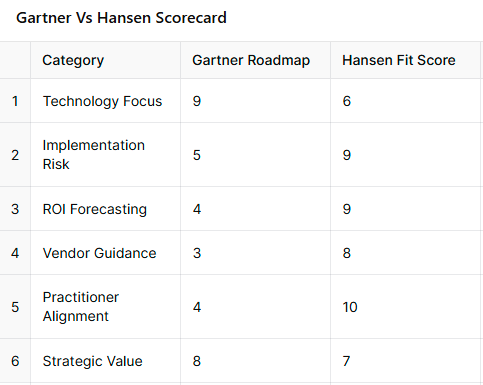
Conclusion
This Gartner roadmap provides valuable market intelligence for MSE technology planning, but requires Hansen’s Fit Score methodology to transform it from theoretical guidance into actionable implementation strategy. Hansen’s models “turn high-level consultancy frameworks into actionable, outcome-driven strategies” by providing deeper predictive accuracy, lower-risk implementations through contextual alignment, and measurable ROI beyond theoretical benchmarks.
The combination addresses Gartner’s key limitations—static analysis, technology-centric bias, and lack of practitioner readiness assessment—while preserving the valuable peer benchmarking and market trend insights that make the original research useful for midsize enterprises.
Bottom Line: Hansen models transform Gartner’s directional guidance into a predictive, profit-driven playbook.
30
QUESTION: Why is it time to move beyond conceptual understanding and the theoretical application of ProcureTech solutions?


 Procurement Insights
Yulia
July 1, 2025
Spot-on analysis. Gartner’s MSE roadmap excels at strategy but falls short on execution—precisely where Hansen’s models (Fit Score, Metaprise, ABM, Strand) add critical value: granular fit-assessment, 30–50% faster implementation, and cross-functional adaptability. For MSEs, turning high-level guidance into outcomes requires tools that operationalize these principles. Solutions like Accio AI embody this shift—automating complex procurement workflows with AI-human collaboration to accelerate ROI, reduce risk, and align tech adoption with unique operational realities. Strategy plus execution is the 2025 imperative.
piblogger
July 1, 2025
I will have to check out your company, Yulia.