The Preface For Today’s Post
In 2014, I gave a lecture at the Virginia Forum about bridging the gap between procurement and finance. The Commonwealth’s eVA initiative had already been successful – it had been since its launch in the early 2000s. The reason they asked me to speak on the subject is that my earlier Procurement Insights articles on the finance-procurement issue had been well-received, and the State CPO and leadership wanted to improve relationships between the two departments.
Before starting the session, I asked the people sitting at the tables to join other tables. In other words, instead of all finance people sitting as a separate group and procurement people sitting as a separate group, I wanted a mix of both procurement and finance people at each table. The method was to create a dialogue between people who likely had never spoken to one another directly.
The success of the process was that many of the procurement and finance personnel were meeting face-to-face for the first time. I then proceeded to deliver my interactive session, which involved active audience participation, where the dialogue that started in that room extended well beyond the session itself. That was the reason for the honor. Even though Virginia’s eVA program was successful, its leadership identified an area for improvement.
Here is the link to the article on which the above preface is based: Virginia Honor Leaves Me Both Humbled and Speechless.
Today’s Post
Leveraging the RAM 2025 multi-model/level platform, I went through the Procurement Insights Archives. I asked for all articles I had written on “bridging the gap between finance and procurement, and how it related to the new 2025 Spend Matters post on which I was tagged to comment.
Here is my response, which won’t fit in a LinkedIn comment due to character limitations, but I will share the link there as part of my reply.
19 Years, Same Problem: Why Technology Can’t Fix What Human Connection Broke
I was tagged to comment on a Spend Matters post today on bridging the gap between procurement and finance, and here is my response.
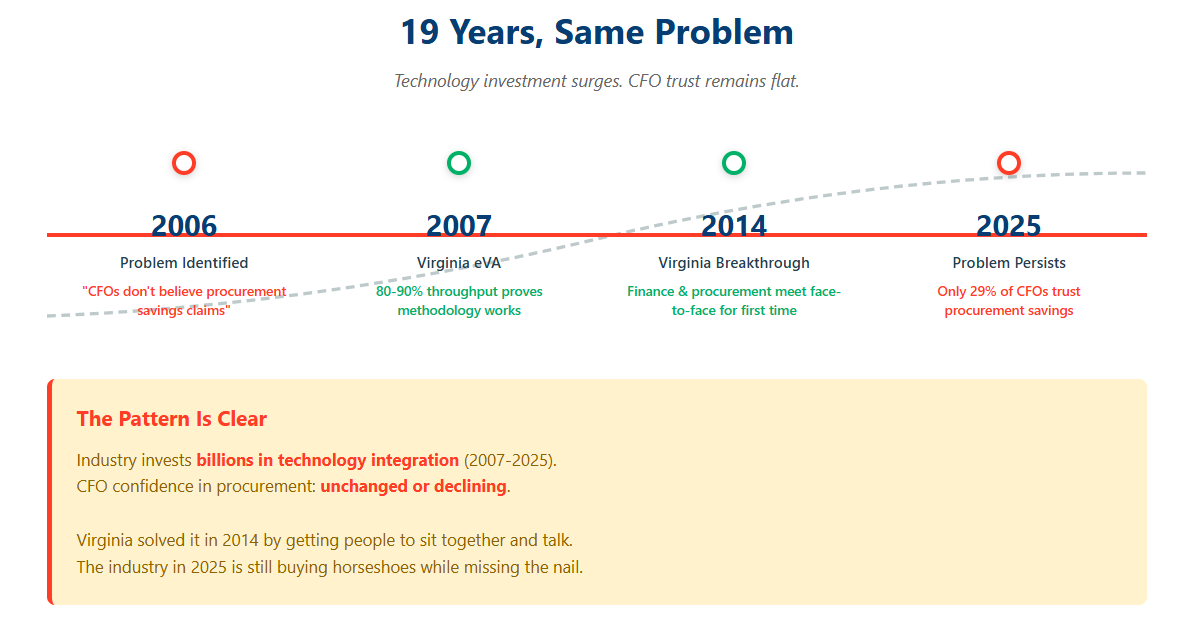
2006: The Problem Identified
In May 2006, Purchasing Magazine published “How to Speak Like a CFO” by Susan Teague. The article’s opening line captured a problem that would persist for nearly two decades:
“Finance executives in Corporate America simply don’t believe that purchasing departments are really bringing in the savings they claim.”
The article prescribed the solution: procurement professionals needed to learn finance’s language—ROIC, EPS, profit & loss statements, working capital. Bob Rudzki of Greybeard Advisors stated it plainly: “Understand return on invested capital (ROIC) and earnings per share. Those concepts drive C-level attention because they are what Wall Street and bankers are interested in.”
2007: Virginia’s eVA Proves Methodology Works
While the industry ignored the 2006 diagnosis, the Commonwealth of Virginia demonstrated what implementation methodology could achieve. I documented Virginia’s eVA program growing from <1% throughput in 2001 to 80-90% by 2007—proving that process archaeology and organizational readiness mattered more than technology selection.
By 2014, Virginia’s operational success was undeniable: more than a decade of sustained results, an expanding supplier base, and consistent performance.
2014: Even Success Has a Hidden Gap
Despite eVA’s documented success, Virginia’s State CPO and leadership identified activiely identified areas for potential improvement. Finance and procurement were one of the areas on which they wanted to focus.
They invited me to present on “Bridging the Disconnect between Finance and Purchasing” at the 2014 Public Procurement Forum. Before starting the session, I did something revealing but straightforward:
I asked everyone to switch tables.
Finance people had been sitting with finance people. Procurement people with procurement people. I mixed the groups—directing finance and procurement professionals to sit together.
What happened next was stunning: Many of these people were meeting face-to-face for the first time, despite working for the same organization for years.
The interactive session that followed created dialogue between groups that had operated in parallel universes. The conversation that started in that room extended well beyond the session itself—procurement and finance professionals actually talking to each other as partners, not adversaries or strangers.
The Commonwealth of Virginia flew an American Flag over the State Capitol in recognition of this contribution. The Director wrote that the presentation “was extremely helpful to an extraordinary number of the Commonwealth’s procurement staff.”
The Deeper Lesson
Virginia’s story reveals something the industry still doesn’t understand:
You can have operationally successful procurement and still fail at organizational integration.
eVA worked. The methodology worked. The results were documented. However, procurement and finance personnel in the same building had infrequently sat together and discussed their work. They didn’t distrust each other because procurement couldn’t speak ROIC—they hadn’t spoken at all.
You can’t teach procurement to speak CFO language if procurement and finance have never had a real conversation. The literacy gap exists downstream of the relationship gap.
2025: The Problem Persists Because We’re Solving the Wrong Thing
Fast forward to September 2025. A Fine Tune/CFO Leadership survey of over 100 CFOs reveals:
- Only 29% of CFOs in large companies have high confidence in procurement’s ability to deliver measurable P&L-aligned savings
- Just 38% overall believe procurement savings actually reach the bottom line
- Confidence drops to 32% in public, VC-backed, or investor-owned firms
But here’s what the survey doesn’t ask: Have your CFO and CPO ever sat at the same table and talked about value creation without PowerPoint decks and formal presentations?
What Happened Between 2006 and 2025?
The procurement technology industry invested billions:
- Enterprise ERP integration
- S2P platforms with AI analytics
- Real-time procurement dashboards
- Automated savings tracking
- Dynamic discounting platforms
All designed to create “visibility” and “alignment” between finance and procurement.
Yet CFO trust stayed flat or declined. Why?
Because integrated systems don’t create human relationships. You can connect ERP to S2P platforms, but if finance and procurement people have never sat together and talked, the technology just automates dysfunction.
September 2025: Spend Matters Prescribes Even More Technology
Spend Matters published “From Digital Finance Vision to Execution: The Role of ProcureTech,” arguing:
“Finance cannot transform without procuretech, and procurement cannot justify tech investment without finance.”
The solution? More technology:
- AI-based data cleansing
- Agentic AI orchestration
- Cross-functional platform integration
- “Joint requirement definition between finance and procurement”
That last phrase is particularly telling: “joint requirement definition.”
How do you jointly define requirements when the two groups have never sat at the same table? When they’ve never had an actual conversation about objectives, constraints, and trade-offs? And even if they did, how would they communicate in a mutually understood language, leading to both shared and individual outcomes?
Why Spend Matters Is Wrong (And Virginia’s 2014 Lesson Proves It)
I know that stating outright that Spend Matters is wrong may come across as harsh or overly critical. Still, Virginia’s 2014 experience revealed the brutal truth: even operationally successful procurement organizations have behavioral silos that prevent the capture of strategic value.
The problem isn’t:
- Lack of financial literacy (though that matters)
- Missing technology integration (though that helps)
- Insufficient data visibility (though that’s useful)
The problem is that Finance and procurement typically operate as separate entities within the same organization.
Spend Matters prescribes:
- “Real-time procurement data flowing into financial dashboards”
- “Shared KPIs and aligned investment roadmaps”
- “Co-defining requirements and jointly evaluating platforms”
But you can’t co-define anything if you’ve never co-conversed.
The Sequence That Actually Works
Industry sequence (fails): Buy technology → Integrate systems → Hope collaboration emerges
Spend Matters sequence (still fails): Define shared strategy → Deploy AI orchestration → Alignment happens
Virginia’s proven sequence:
- Put people at the same table → Physical proximity forces human connection
- Create dialogue without hierarchy → Procurement and finance talk as peers
- Build shared understanding → Each group learns what the other actually needs
- Then teach financial literacy → Procurement learns ROIC/EVA/EPS in the context of the relationship
- Deploy technology last → Systems amplify already-functional human collaboration
Virginia’s leadership understood something sophisticated: technical success doesn’t eliminate organizational friction. You have to actively build the human bridge.
The Evidence Trail
- 2006: Problem identified—CFOs don’t believe procurement savings
- 2007: Virginia eVA proves implementation methodology works operationally
- 2014: Virginia leadership recognizes that even successful operations need a finance-procurement relationship building
- 2014: Simple intervention (mixing tables, creating dialogue) honored by the Commonwealth
- 2015-2025: Industry invests billions in technology while ignoring human dynamics
- 2025: Only 29% of CFOs trust procurement savings
Virginia solved the operational problem in 2007. They solved the relationship problem in 2014. The industry in 2025 still hasn’t solved either one.
What Actually Works
The 2014 Virginia session proved the solution is embarrassingly simple:
Make them sit together. Make them talk.
Not through:
- Integrated dashboards
- Shared KPI frameworks
- Joint steering committees
- Cross-functional platform assessments
But through actual human conversation. Procurement and finance professionals at the same table, discussing real problems, without formal agendas or PowerPoint presentations.
Then and only then can you:
- Teach financial literacy (because a relationship creates receptiveness)
- Deploy technology (because collaboration already exists)
- Track shared KPIs (because both groups care about the same outcomes)
- Build CFO trust (because procurement speaks from understanding, not scripts)
The Brutal Truth
Spend Matters prescribes horseshoes (technology integration, AI orchestration) while ignoring the nail (human relationships between finance and procurement).
The Virginia 2014 lesson:
Even when you have the horseshoe working (eVA operational success), you still need the nail (human connection). Leadership recognized this and brought in someone to facilitate dialogue, not implement better technology.
The Commonwealth flew a flag over the State Capitol not for building a better S2P platform, but for getting finance and procurement people to sit together and talk.
2025: Still Buying Horseshoes
Spend Matters’ latest prescription: agentic AI, cross-functional platforms, automated workflows.
Missing: any acknowledgment that finance and procurement might need to actually know each other as human beings before “jointly defining requirements.”
You can’t automate trust. You can’t integrate your way to collaboration. You can’t AI-orchestrate human relationships.
Virginia proved this in 2014. The 2025 CFO survey confirms what happens when you ignore it.
The Question Nobody’s Asking
Before investing in the next wave of procurement technology, ask this:
Have your CFO and CPO ever sat at the same table—without an agenda, without a formal presentation, without a technology vendor pitch—and just talked about what success looks like?
If the answer is no, you don’t have a technology problem. You have a relationship problem. And no amount of AI orchestration will fix it.
Virginia didn’t need agentic AI to build finance-procurement collaboration in 2014. They needed people to sit at the same table and talk. That’s still true in 2025. It will be true in 2035.
The pattern is clear. The solution has been proven. Yet the industry keeps buying expensive horseshoes while wondering why finance and procurement still don’t trust each other.
30


 Procurement Insights
Tim Cummins
September 30, 2025
I recall us being together in VA and relishing the success that had been achieved. As you rightly say, the value potential from procurement continues to be missed in too many places. I’m sure you’ve read our recent research on this topic and how it could be turned around.
On technology, I agree that it won’t help much if the broader role, purpose and measurements of procurement aren’t changed. But I suggest that technology is important: right now, it’s not the right technology – it supports an outdated purpose. And that’s something we could discuss at greater length!
piblogger
September 30, 2025
That would be a great discussion to have, Tim. In the meantime, please share the link to your recent research.