What Coca-Cola Consolidated, Wayne State, and White Cap Teach Us About Why Procurement Transformations Fail.
INTRODUCTION:
Three articles published in the SIG University series this week (October 20-22, 2025) inadvertently documented the complete lifecycle of procurement transformation – and revealed exactly why fewer than 5% achieve sustained ROI.
Individually, each article offers valuable insights. Together, they reveal the pattern I’ve been documenting for 27 years: Technical capability without behavioral readiness creates expensive failures.
Let me show you what I mean.
ARTICLE 1: The Enthusiasm (Technical Capability)
Makayla Allen’s “Transforming Procurement with AI” describes what AI CAN do at Coca-Cola Consolidated:
- Advanced data analytics for decision-making
- Enhanced supplier relationship management
- Cost optimization through spend analysis
- Automation of routine tasks
- Scenario modeling for market volatility
Her enthusiasm is genuine and well-founded. Every capability she describes is technically valid.
What’s missing: Any mention of how to ensure the organization is READY to execute with these tools.
Zero discussion of:
- Verification discipline for AI outputs
- Conversational AI fluency requirements
- Behavioral readiness assessment
- Risk of AI hallucinations in procurement decisions
- How to measure actual ROI vs. claimed benefits
This is the 95% failure pattern: Describing WHAT technology can do without addressing HOW to ensure readiness.
ARTICLE 2: The Success (Implementation Readiness)
Brad Micciche’s Wayne State University case study shows HOW transformation succeeds:
Before Launch:
- In-person seminars and training sessions
- Process re-engineering (not just automation)
- Understanding transition at high level
During Launch:
- Simple, accessible training
- System configured to match behavioral patterns
- User-friendly interface
Results:
- “Eagerness as opposed to resistance”
- “Very little change management needed”
- $2.5M annual savings
- 95% platform adoption
- Requisition time reduced 3+ days → under 2 days
Wayne State succeeded because they sequenced readiness BEFORE acceleration.
They accidentally executed Hansen Fit Score principles:
- Technical Capability: Selected JAGGAER after rigorous RFP
- Behavioral Alignment: Training + process re-engineering created readiness
- Readiness Compensators: User-friendly design + configurability reduced friction
This is the 5% success pattern: Implementation readiness embedded in deployment approach.
ARTICLE 3: The Reality (Sustained Management)
Rich Young’s White Cap case study reveals what happens AFTER successful deployment:
“Contracts may be sound at signature, but their value erodes over time through discretionary fees, off-contract creep, inventory drift, and site-level exceptions.”
This is the behavioral alignment gap playing out in real-time.
Rich identifies three required capabilities for sustained success:
- Category expertise (knowledge)
- Technology designed for the task (tools)
- Continuous management (behavioral discipline)
“Without any one, execution slips.”
He’s describing ongoing Hansen Fit Score assessment:
- “Governance that survives organizational change”
- “Daily rigor, purpose-built measurement”
- “Monitoring designed for each category’s nooks and crannies”
- “Measure what sticks, not just what’s sourced”
The critical insight: “Good contract, Bad deal” happens when behavioral alignment erodes between sourcing events.
THE PATTERN ACROSS ALL THREE:
Makayla (Technical Capability): “AI can transform procurement” → TRUE, but only with readiness
Wayne State (Implementation Readiness):
“Training + re-engineering before deployment” → This IS readiness in action
White Cap (Sustained Management): “Value erodes without continuous behavioral alignment” → Readiness must be maintained
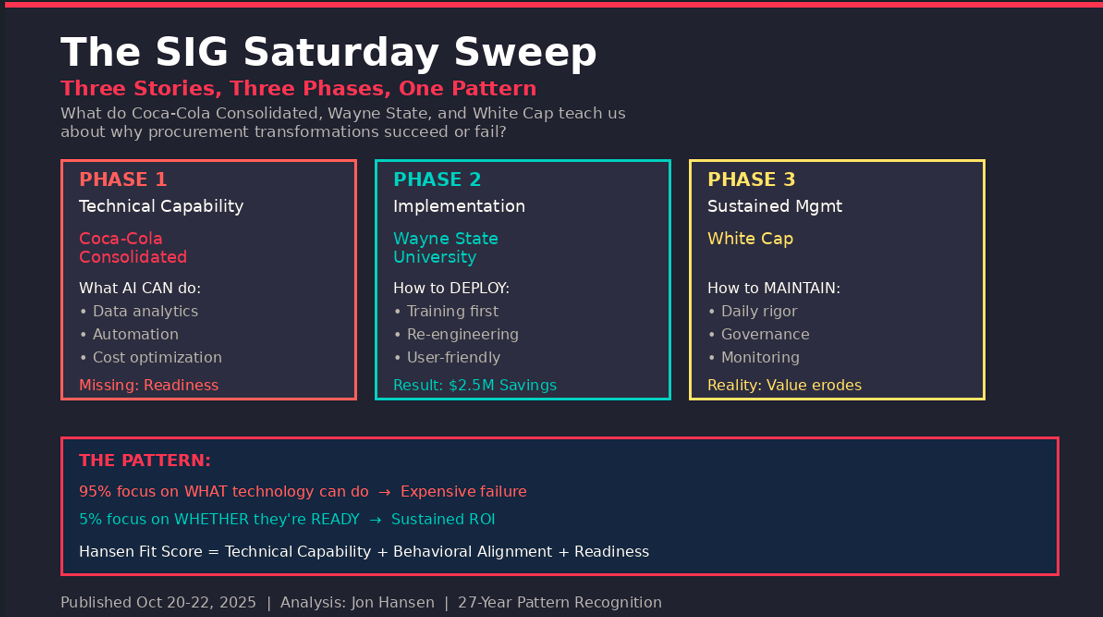
Together, they reveal the complete transformation lifecycle:
PHASE 1: Technical Capability (What CAN we do?) PHASE 2: Implementation Readiness (How do we DEPLOY it?) PHASE 3: Sustained Management (How do we MAINTAIN it?)
The 95% who fail focus only on Phase 1. The 5% who succeed execute all three phases.
WHY THIS MATTERS NOW:
In October 2025, McKinsey’s investor survey revealed that capital markets no longer reward technology adoption as success. They’re demanding proof of:
- Return (62%)
- Growth (43%)
- Profitability (30%)
Translation: “Show us outcomes, not features.”
This is exactly what Rich Young describes: “Measure what sticks, not just what’s sourced.”
And it’s exactly what Wayne State achieved: Sustained $2.5M annual savings with 95% adoption.
And it’s exactly what Makayla’s article doesn’t address: HOW to ensure AI capabilities become measurable ROI.
THE HANSEN FIT SCORE FRAMEWORK:
All three articles validate what I’ve documented for 27 years:
Technical Capability (Makayla’s AI tools, JAGGAER’s platform, Fine Tune’s technology) + Behavioral Alignment (Wayne State’s training, White Cap’s governance, continuous management) + Readiness Compensators (User-friendly interfaces, external partnerships, category expertise) = Sustained ROI (Wayne State’s $2.5M, White Cap’s “Good contract, Good deal”)
Without all three, you get:
- Makayla’s risk: 95% failure despite valid technical capability
- Rich’s warning: “Value erodes” even after good contracts
- The pattern I’ve documented since 1998
WHAT PROCUREMENT LEADERS SHOULD DO:
Before selecting technology (Makayla’s phase):
- Assess organizational behavioral readiness
- Measure conversational AI fluency
- Establish verification discipline protocols
During implementation (Wayne State’s phase):
- Training and re-engineering BEFORE deployment
- Configure systems to match behavioral patterns
- Create user-friendly interfaces that reduce friction
After go-live (White Cap’s phase):
- Continuous monitoring for behavioral drift
- Governance that survives organizational change
- Daily rigor with purpose-built measurement
- Track “what sticks” not just “what’s sourced”
THE TAKEAWAY:
Three articles. Three phases. One pattern.
Technical capability without behavioral readiness = expensive failure.
Makayla’s enthusiasm for AI is warranted – but needs Wayne State’s readiness approach.
Wayne State’s success is remarkable – but requires White Cap’s sustained management.
White Cap’s governance model works – but prevents Makayla’s failure pattern.
The question isn’t whether AI can transform procurement. It can.
The question is whether your organization is READY to transform WITH it.
That’s what the Hansen Fit Score measures. That’s what The October Diaries documents. That’s what these three articles – published within 48 hours of each other – inadvertently proved.
The 95% focus on what technology CAN do.
The 5% focus on whether they’re READY to do it.
Which are you?
30


 Procurement Insights
Tim Cummins
October 25, 2025
This is absolutely right Jon. Tech can’t drive the change. It can only enable it. Our 2025 benchmark shows procurement dropping off and suppliers changing the power balance