A Hansen Fit Score Reality-Check on James Meads’ 2025 Mid-Market P2P List
Jon W. Hansen | Procurement Insights | December 2025
“Trying to get your data ready at the same time as you are implementing a provider’s solution is like packing your bag to go on a trip while chasing the train as it is leaving the station.”
— Rob Handfield
Rob’s analogy captures everything wrong with how the industry approaches procurement technology. The train is moving at vendor speed. You’re running behind it, stuffing processes, data, and governance into your bag as you go. Even if you catch it, you arrive disheveled with half of what you need.
That’s the 80% failure rate in a single image.
James Meads just published one of the cleanest mid-market Procure-to-Pay shortlists I’ve seen in years. No vendor fluff, no paid placements — just practical guidance for companies in the $50M – $1B revenue bracket.
I like James. I also like the list.
But here’s the uncomfortable truth nobody on the list — or most shortlists — ever tells you:
Even the #1 tool on the planet will fail 60–80% of the time if your internal readiness isn’t there first.
The Cruel Truth About Tech Lists
When you read procurement technology lists — the “Top 11 P2P solutions” or the latest “AI platforms” — they all focus on the Provider (the instrument). They tell you about features, speed, and cost. They are generally not wrong.
But they miss the single most critical variable: You.
The 80% failure rate in enterprise IT isn’t due to bad software; it’s due to bad organizational architecture. The tool is often excellent, but the musician (your organization) is out of sync.
We need to flip the script. Instead of asking, “Which software should I buy?”, we must ask:
“What is my organization’s minimum readiness score to succeed with this tool?”
What James Does Well
Credit where it’s due. James’s list is better than most because:
- He’s explicitly mid-market — not “one size fits all”
- He talks about ROI and implementation speed — not just feature bingo
- He’s transparent — “this is not sponsored content”
- He acknowledges fit matters — “there is no right or wrong answer… it boils down to size, maturity and requirements”
That last point is the crack in the door. James knows readiness matters — but “maturity” is mentioned, never measured. There is no mechanism to say:
- “You’re at 58/100, so Tool X will drown you.”
- “You’re at 82/100, so Tool Y will actually be underpowered.”
The Missing Variable: Practitioner Readiness
The Hansen Fit Score (HFS) provides the answer. It is Productized Scar Tissue — a quantified measure of your organization’s capability to absorb, govern, and extract value from a new technology, based on decades of watching transformations fail and succeed.
The HFS measures readiness across five dimensions:
- Technical/Operational Fit (TOF) — Infrastructure, integration capability, data quality
- Behavioral Readiness (BR) — Change adoption, stakeholder alignment, process discipline
- Governance Maturity (GM) — Decision rights, accountability structures, policy enforcement
- Strategic Alignment (SA) — Executive sponsorship, business case clarity, outcome definition
- Ecosystem Readiness (ER) — Supplier capability, market conditions, external dependencies
HFS Readiness Bands
For mid-market P2P deployments, here’s what the bands mean:

The HFS Fit-Mapping: James Meads’ P2P List
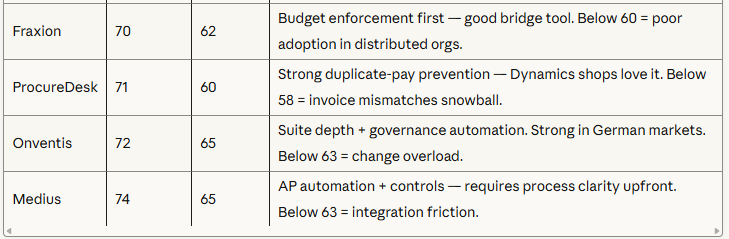
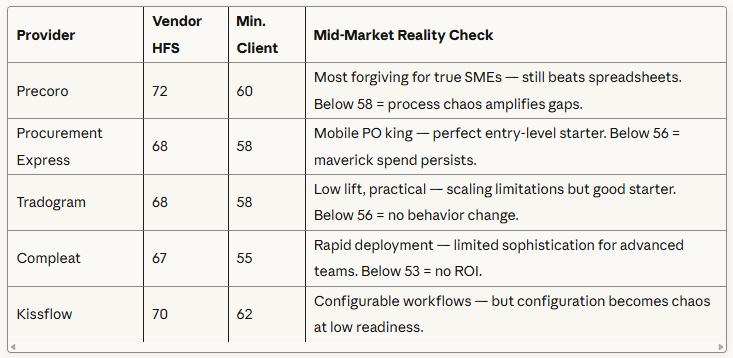
We took James’s vendor list and ran each through the Hansen Fit Score lens. The result is the table every mid-market CPO should review before booking the first demo.
The Minimum Client Readiness column shows the threshold needed for >80% success probability. Below that threshold, even a five-star G2 review won’t save you.
High-Velocity / Card & Expense-Led (Requires HFS 67-72)
These assume strong finance ownership, card/expense sophistication, and cross-functional data discipline.

Mid-Market P2P Suites (Requires HFS 60-66)
Solid mid-market tools assuming basic workflow ownership, approvals, and catalog discipline.

30
Entry-Level / Early-Stage Friendly (Requires HFS 55-62)
Lighter-weight tools that can start earlier — ideal when the goal is “remove chaos first, mature later.”
The One Number You Must Know Before You Click “Book Demo”
If your internal Hansen Fit Score is below the “Minimum Client Readiness” column for the tool you love, you are volunteering for the 80% failure club, no matter how many five-star G2 reviews it has.
The Mid-Market Sweet Spot (2025 Reality)
- 55-62 internal readiness → Stick with Precoro, Procurement Express, Tradogram, or Compleat. They’re forgiving and still beat Excel chaos.
- 63-69 internal readiness → Procurify, Planergy, Prokuria, Vroozi, Fraxion are your playground. 80-90% success odds.
- 70+ internal readiness → Go big with Ramp, Airbase, Payhawk. You’ve earned the right to move at fintech speed.
Why Fit Matters More Than Features
Here is the truth that every transformation veteran eventually learns:
Capability ≠ Readiness
Software ≠ Process discipline
Tools ≠ Behaviors
Features ≠ Outcomes
When an initiative fails — and 80% historically do — it is not because the software is bad. It is because:
- Processes weren’t aligned
- Governance wasn’t stable
- Data wasn’t ready
- Change fatigue was misdiagnosed
- Stakeholder alignment wasn’t there
- Internal physics resisted the change
A P2P system amplifies your current state. If the state is messy, the platform becomes messy.
The Kroger Lesson
This isn’t theory. Kroger just did a $2.6 billion write-down on robotic fulfillment centers. The robots worked fine. The organizational readiness didn’t.
I documented this exact pattern in a 2008 white paper. Hershey, HP, Cadbury, FoxMeyer — hundreds of millions lost because organizations deployed technology before measuring readiness. Seventeen years later, the pattern hasn’t changed. Only the dollar amounts have — from millions to billions.
The 80% failure rate isn’t a cost of doing business; it’s a direct result of choosing to bypass Phase Zero: Readiness Assessment.
How to Use James’s List + HFS Together
Step 1: Score Your Readiness First
Before you shortlist from any list — including this one — use HFS to score your current practitioner readiness. Be honest. Most organizations overestimate because they measure capability (“we could do this”) rather than reality (“we consistently do this”).
Step 2: Match Technology to Your Band
From James’s list, only consider tools whose assumed band overlaps your current score or your realistic 18-24 month target. If your HFS is 58 and the tool requires 70, you’re buying a Formula 1 car for someone who just got their learner’s permit.
Step 3: Invest in Readiness, Not Just Technology
For tools above your band, you have two choices:
- Delay the purchase and invest in fixing your Practitioner and Context issues (Phase Zero).
- Choose to fail and contribute to the analyst industry’s renewable revenue source.
Bottom Line
James’s list is excellent for discovery. The Hansen Fit Score table above is what turns discovery into deployment success.
Run your internal readiness assessment first. Then pick from the list with confidence instead of hope.
Because in 2025, the best tool in the world is still the wrong tool if your foundation can’t hold it.
Failure is a choice. Choose wisely.
30

The framework in plain English:
- Entry-Level (HFS 55-62): Precoro, Procurement Express, Tradogram, Compleat — these providers are designed for organizations with lower readiness. They’re forgiving, lighter-touch, and won’t overwhelm a team that’s still building process discipline. If you’re at 55-60, these are your match.
- Mid-Market Suites (HFS 60-66): Procurify, Planergy, Prokuria, Vroozi, Fraxion, ProcureDesk, Onventis, Medius — these assume you’ve got basic workflow ownership, approvals, and some catalog discipline in place. If you’re at 60-66, you’re in the sweet spot for these tools.
- High-Velocity (HFS 67-72): Ramp, Airbase, Payhawk, Spendesk, PayEm, Flowie — these are card/expense-led, finance-driven platforms that assume strong cross-functional data discipline and mature controls. If you’re below 67, they’ll overwhelm you. If you’re at 67-72, you’ve earned the right to move at fintech speed.
The key insight:
This isn’t about which provider is “best” — it’s about which provider is best aligned to where you are right now.
A practitioner at 58 buying Ramp isn’t getting a better tool. They’re getting a tool that will amplify their gaps and become shelfware.
That’s the whole point of the missing column.


 Procurement Insights
Tahj Bomar
December 1, 2025
Hi, J