Something shifted this year.
Over the past several months, I’ve noticed an increasing number of academic thought leaders — professors of strategic management, digital transformation researchers, automotive industry specialists — reaching out to connect directly. Not to debate. Not to critique. To access the Procurement Insights archives.
This morning, a professor with 15+ years teaching strategic management and 20 years as an international executive at a major technology firm sent a connection request. His recent posts focus on the crisis facing German automotive suppliers — insolvencies up 50%, 50,000+ jobs lost, banks cutting credit, Mittelstand companies crushed by global procurement platforms.
His proposed solution: deeper ecosystem integration with OEMs, co-value creation, shared know-how.
What caught my attention is that this is exactly the governance structure I documented in 2010 — 15 years ago — in a two-part lecture series at eWorld on global value chains.
What the Archives Show
In those lectures, I mapped the quasi-hierarchy model identified by Humphrey and Schmitz: “relationships between legally independent firms in which one is subordinate to the other, with a leader in the chain defining the rules to which the rest of the actors have to comply.”
I traced this back to E.G. Robinson’s 1931 work on external economies of scale — immobile versus mobile structures — and showed how governance determines whether suppliers thrive or get squeezed.
The case studies were stark:
- Wal-Mart and Vlasic Pickles — A premium brand squeezed to bankruptcy by platform economics. “We’ve done to pickles what we did to orange juice. We’ve killed it.”
- Tesco and Zimbabwe mangetout — A retailer controlling production parameters for farms it didn’t own.
- Mattel’s paint scandal — The capability gap between domestic and export market requirements.
The data I cited then: 84% of executives believed their company was not prepared to respond to supply chain disruption (Aberdeen, 2008).
Seventeen years later, the German automotive suppliers this professor is writing about are living that unpreparedness.
The Question They’re Not Asking
The professor’s solution — ecosystem integration — assumes suppliers are ready to integrate. But readiness is the gate, not the outcome.
The question isn’t just “how do we integrate into OEM ecosystems?”
It’s: “Are we ready to absorb integration without becoming subordinate?”
That’s Phase 0 — the readiness diagnostic that should precede the architecture decision. And it’s the layer that’s still missing from most transformation frameworks, whether in automotive, procurement technology, or AI adoption.
The Audience Shift
When I launched Procurement Insights in 2007, the readership was primarily operational practitioners — buyers and procurement staff looking for tactical guidance.
Eighteen years later, the composition has inverted. Today, approximately 90% of engaged readers are strategic decision-makers: academics researching transformation patterns, C-Suite executives evaluating AI readiness, and senior practitioners (CPO/VP level) responsible for technology investment decisions.
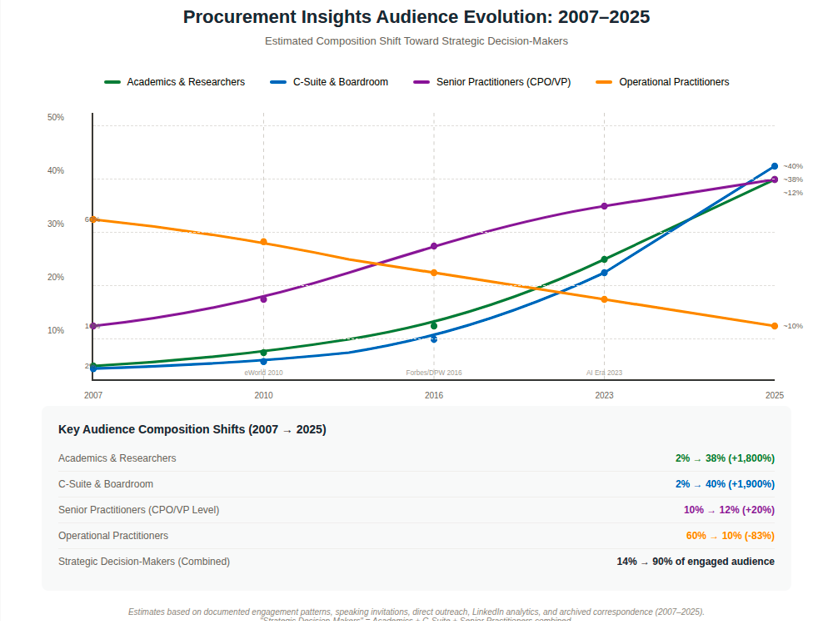
Key Audience Composition Shifts (2007 → 2025):
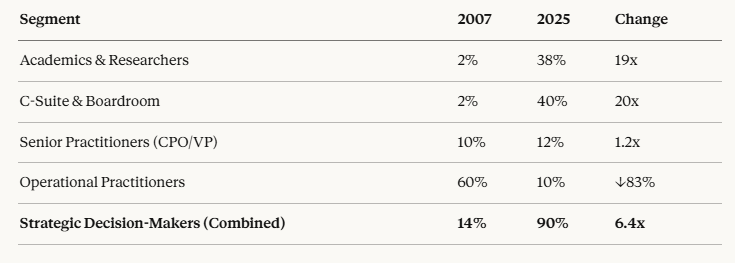
The content didn’t change. The recognition of what it documents did.
Why This Matters for Business Leaders
When academics start mining an 18-year practitioner archive for primary source material, it signals something:
The empirical documentation of what actually happens in procurement transformation — the patterns, the failures, the 80% implementation failure rate, the governance structures that determine outcomes — isn’t sitting in academic journals. It’s sitting in the archives of practitioners who were watching while the industry was doing.
For nearly three decades, I’ve documented what works, what fails, and why. Not from theory. From production environments, government-funded R&D, and thousands of conversations with practitioners living the reality.
If the academic community is now reaching out to access that foundation, the question for business leaders is simple:
What are you missing by not doing the same?
The Archive Evidence (For Those Ready to Explore)
Global Value Chains & Automotive Coverage
- Global Value Chains: 1931 to 2025
- IBM’s AutoDX vs. Covisint
- Reverse Auctions and the Automotive Industry: A History of Discontent
- Will the Ghost of Harold Kutner Still Haunt GM?
- Cluster Development and Public Sector Procurement
- Public Sector Procurement and External Economies
Foundational Methodology
- Yes Virginia! There is more to e-procurement than software! (Part 1) — September 2007
- Similarity Heuristics, Iterative Methodologies and the Emergence of the Modern Supply Chain — April 2008
- Dangerous Supply Chain Myths (Part 7): Enabling Technology – The Emergence of the Metaprise — 2007/2011
The Pattern Across Industries
What the German automotive professor is discovering isn’t unique to his sector. The same governance structures, the same readiness gaps, and the same failure patterns appear across:
- Procurement Technology — 80% implementation failure rate
- AI Transformation — Organizations deploying before they can absorb
- Global Supply Chains — Suppliers squeezed by platform economics they weren’t ready to navigate
- Digital Transformation — Technology scaling dysfunction instead of capability
The common thread: architecture without readiness assessment.
That’s Phase 0. And it’s why academics are finding the archives.
A Final Thought
I didn’t set out to build a research archive. I set out to document what I was seeing — the patterns, the failures, the rare successes, and the reasons behind each.
Eighteen years later, that documentation has become something academics and executives are seeking out. Not because it tells them what to buy. Because it tells them what actually happens when organizations try to transform.
If you’re a business leader still relying on vendor presentations and analyst quadrants to guide your transformation strategy, consider this:
The people whose job is to research what works are now coming to the practitioner archives.
Maybe you should too.
Jon Hansen is the creator of the Hansen Method and the Hansen Fit Score (HFS) framework for procurement transformation. He has documented procurement technology patterns since 2007 through Procurement Insights, building on foundational research conducted in 1998 through Canada’s SR&ED program. His work focuses on preventing the documented 80% implementation failure rate through organizational readiness assessment.


 Procurement Insights
Tim Cummins
January 1, 2026
while we came at this from different angles, our work over those 18 years has regularly coincided. As you know, my interest has been on the commercial models and contracting practices that have led to today’s challenges – and continue to constrain change. Ecosystems and extended supply chains are a direct result of procurement strategies focused on low cost. Whether these were ever a good idea is beside the point: it leaves us with a destructive trail of diminished trust, low levels of collaboration and confrontational behaviour. Recovery is not quick or easy – and right now, the approaches to contracting and negotiation show few signs of change.
piblogger
January 1, 2026
Tim — it’s meaningful to see our work continue to intersect after all these years. You’ve documented from the commercial and contracting side what I’ve documented from the procurement technology side: the same destructive patterns, the same trust erosion, the same rigidity spiral.
Your point lands hard: “Ecosystems and extended supply chains are a direct result of procurement strategies focused on low cost.” That’s the governance structure I mapped in 2010 — quasi-hierarchy models where suppliers become subordinate, not partners. Vlasic, Tesco/Zimbabwe, and now German automotive suppliers are all living the consequences.
But it’s your observation about “low levels of collaboration and confrontational behaviour” that raises the deeper concern. AI is an extension of human thinking. If it’s deployed as a transactional extraction tool — which most organizations default to — it won’t heal those divides. It will widen them at machine speed. The behavioral readiness question may be more important than the technical one.
The convergence of our work isn’t accidental. We’ve been watching the same failure mode from different angles for nearly two decades. The question now is whether organizations will finally address the readiness gap before the next technology wave — or repeat the cycle again.
Here’s to the 20% who get it. And to the work of expanding that number.
Tim Cummins
January 1, 2026
you highlight how AI use could make things worse – and in my work with AI, the tools acknowledge that point. In fact, all we’d achieve is to create problems faster. Ai is a tremendous asset when used by intelligent humans: therein lies our problem!
piblogger
January 1, 2026
Tim — “All we’d achieve is to create problems faster” should be the warning label on every enterprise AI deployment. And your closing line is the one most vendors hope no one says out loud: the bottleneck was never the technology. It’s whether the humans using it are ready to use it well. That’s the readiness gap in one sentence.