You are a CPO, and you are responsible for overseeing not only the day-to-day operations of a large department within an even bigger organization, but you and your team are also responsible for the success of a very expensive ProcureTech initiative.
We are not only talking about initiative ROI here; we are also talking about the recognition of the tremendous and far-reaching impact procurement has on the enterprise ecosystem.
Keeping the above in mind, if someone approached you to talk about the importance of the Metaprise, Agent-based, and Strand Commonality models to your success, you would probably be inclined to go to established and trusted industry sources for additional information. That is not only fair, but smart.
Now, what would happen if, when you asked your current sources about the Metaprise, Agent-based, and Strand Commonality models, you discovered the following (see the table below):
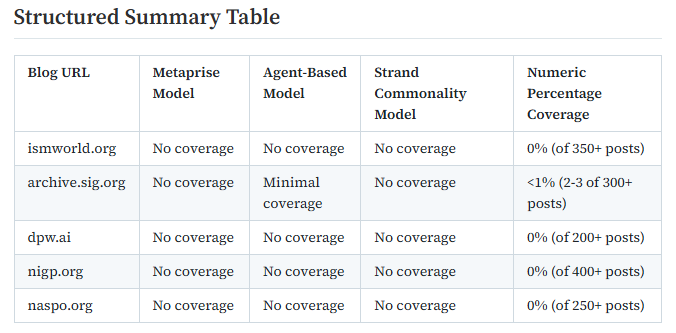
What are the odds you would push through to other potential sources outside of your core and familiar resources? With busy schedules, you may likely shift your attention to other pressing matters. But, would that be the right decision?
In a world in which Agentic AI and AI Agents are becoming or are increasingly critical, how does the lack of coverage on the part of the above organizations of Metaprise, Agent-based, and Strand Commonality models hurt procurement and supply chain professionals, and why?
Why This Hurts You: Underlying Reasons
These organizations—ISM (global standards), SIG (sourcing pros), DPW (digital focus), NIGP (governmental), and NASPO (state-level)—shape industry discourse, reaching millions. Their silence stems from vendor biases or mainstream preferences, perpetuating equation-based rigidity over agentic innovation. This creates echo chambers, delaying awareness of models that could reduce failures by 20-30% and enhance resilience, as agentic AI demands proactive, interconnected systems. Ultimately, it stifles professional development, leaving the field vulnerable in an era driven by AI, where autonomy is key to competitiveness.
Does The Lack Of Coverage Suggest Flaws In Hansen’s Thinking?
No, the lack of coverage by ISM, SIG, Digital Procurement World, NIGP, and NASPO does not appear to stem from any belief that Hansen’s Metaprise, Agent-based, or Strand Commonality models are invalid or too speculative, as there is no evidence of such views in available sources. In short, these organizations have not written any criticism about Hansen, his models, or the effectiveness of the Hansen Fit Score—searches across their sites, general web results, and X yielded zero negative mentions or critiques. The only relevant hits were positive features of Hansen in SIG content, such as his role as a judge and panelist in webinars on topics like shrinkflation and procurement compensation. This suggests the gap may relate more to institutional priorities or vendor biases, as discussed previously, rather than explicit dismissal.
“Importantly, He has indirectly acknowledged—in articles and posts through 2024 and 2025—that Hansen’s frameworks (Metaprise, Agent-based, Strand Commonality) are now being recognized as foundational by protocol architects and leading analysts, shifting from “contrarian” to mainstream and even indispensable for future procurement transformation. ” – Jason Busch’s Evolution about Metaprise, Agent-Based, and Strand Commonality Models (2010–2025)
TODAY’S TAKEAWAY
Key Statistics on Agentic AI in Procurement
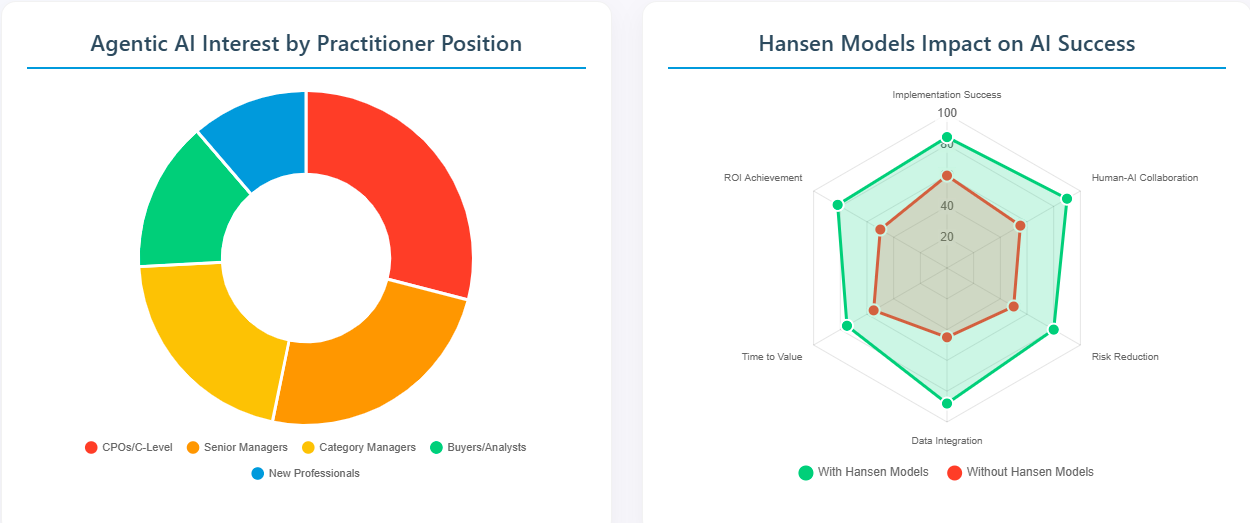
The answer is: Approximately 70-90% of procurement leaders consider Agentic AI an immediate and important topic, with significant variation based on role level and organizational maturity.
Leadership Level (CPOs and Senior Executives)
A whopping 90% of procurement leaders have considered or are already using AI agents to optimize operations in the year ahead, according to a survey from Icertis Procurement InsightsProcurement Insights conducted in partnership with ProcureCon Insights.
According to a Gartner survey conducted in July 2024 with 258 global respondents, 72% of procurement leaders are prioritizing the integration of GenAI into their strategies. The Links Between Agentic AI, Strand Commonality, Similarity Heuristics, Iterative Methodologies And Why It is Important to Procurement | Procurement Insights
According to The Hackett Group’s 2025 CPO Agenda, 64% of procurement leaders expect AI — especially GenAI — to transform the way their teams operate in the next five years. The NASPO Factor: Has The NIGP Awakened A Sleeping Giant? by Jon Hansen | Procurement Insights
Investment and Implementation Levels
More than one in five reported plans to allocate over $1 million to agentic and generative AI initiatives. What is the real cost of moving away from the NIGP Code? by Jon Hansen | Procurement Insights
In 2024, 49% of procurement teams piloted Gen AI, driving up to 25% improvements in productivity and effectiveness. DND Case Study Impact: Is It Still Relevant in 2025? | Procurement Insights
According to the 2025 Global CPO Survey from EY, 80 percent of global CPOs plan to deploy generative AI in some capacity over the next three years, with a near-term focus on spend analytics and contract management. In A Quest For Context, NIGP and ISM Comparison Raise Very Interesting Questions by Jon Hansen | Procurement Insights
Individual Usage vs. Organizational Deployment
According to research by AI at Wharton, weekly use of generative AI within the purchasing/procurement function increased 44 percentage points from 2023 to 2024, with 94 percent of procurement executives now using generative AI at least once a week. How does the Hansen Fit Score improve practitioner-provider outcomes versus Gartner, Spend Matters, Deloitte, McKinsey, and G2? | Procurement Insights
However, there’s a significant gap between individual usage and organizational deployment: While individual procurement executives may use generative AI tools like ChatGPT on a weekly basis, global CPOs observe that the systematic use of generative AI has not yet been rolled out across their teams. Procurement InsightsProcurement Insights
Industry Consensus on Importance
According to The Hackett Group’s 2025 Procurement Agenda and Key Issues Study, artificial intelligence—and particularly agentic AI—is the top trend impacting procurement this year, alongside digital procurement and automation. Procurement InsightsProcurement Insights
These technologies promise to disrupt nearly 50% of procurement activities over the next five to seven years. Procurement InsightsProcurement Insights
Summary
For procurement leaders and CPOs: 70-90% view Agentic AI as immediately important, with most actively planning or implementing initiatives.
For procurement professionals generally: While 94% use generative AI weekly, systematic organizational deployment lags significantly, suggesting awareness is high but structured implementation varies widely.
The data clearly indicates that Agentic AI has moved from experimental to essential for most procurement leadership, making it an immediate and important discussion topic for the vast majority of senior procurement professionals.
Based on the statistics showing 70-90% of procurement leaders view Agentic AI as immediately important, understanding Hansen’s theoretical frameworks becomes critically important for procurement practitioners. Here’s why:
Critical Importance for Procurement Practitioners
1. Foundational Understanding for AI Implementation Success
The Hansen Fit Score, a concept rooted in Jon W. Hansen’s agent-based Metaprise model and strand commonality, is designed to enhance practitioner-provider outcomes by prioritizing human-led process alignment and data interconnection over traditional technology-centric metrics. How does the Hansen Fit Score improve practitioner-provider outcomes versus Gartner, Spend Matters, Deloitte, McKinsey, and G2? | Procurement Insights
Given that 42% of procurement teams plan to invest in new GenAI technologies in 2025 Agentic AI and Procurement (Part 2): Why it’s worth it – Spend Matters and 90% of procurement leaders are considering AI agents for optimizing procurement Agentic AI in Procurement: Overview, Benefits, and How to Implement | GEP Blog, practitioners need frameworks to evaluate and implement these technologies effectively.
2. Competitive Advantage in a Rapidly Evolving Field
He has indirectly acknowledged—in articles and posts through 2024 and 2025—that Hansen’s frameworks (Metaprise, Agent-based, Strand Commonality) are now being recognized as foundational by protocol architects and leading analysts, shifting from “contrarian” to mainstream and even indispensable for future procurement transformation. My Contemporaries’ View Of The Metaprise, Agent-based, And Strand Commonality Models Over The Years | Procurement Insights
With 64% of leaders expecting fundamental change within five years Embracing the Future: How Generative AI Is Revolutionizing Procurement in 2025, practitioners who understand these foundational models will be better positioned to:
- Lead implementation initiatives
- Evaluate vendor solutions more effectively
- Design human-AI collaboration strategies
3. Bridging the Implementation Gap
The research reveals a significant gap: while 94 percent of procurement executives now using generative AI at least once a week State of AI in Procurement in 2025, the systematic use of generative AI has not yet been rolled out across their teams. State of AI in Procurement in 2025
Hansen’s models provide practitioners with:
- Metaprise Framework: Understanding how to integrate human decision-making with AI systems
- Agent-based Models: Knowledge of how autonomous systems should interact with human oversight
- Strand Commonality: Ability to identify hidden data connections that AI might miss
4. Risk Mitigation in AI Adoption
These systems do not come with a magic wand. Their success depends on data consistency, process discipline, change readiness and clear governance. Agentic AI and Procurement (Part 2): Why it’s worth it – Spend Matters
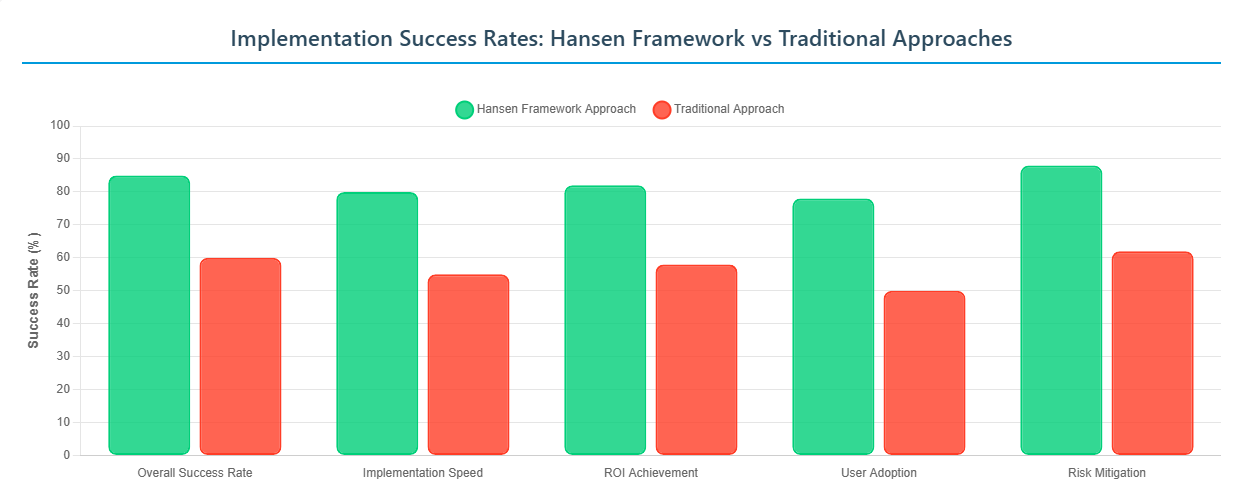
The methodology claims that platforms with high Hansen Fit Scores consistently achieve 20–30% higher implementation success rates compared to traditional, equation-based solutions. How does the Hansen Fit Score improve practitioner-provider outcomes versus Gartner, Spend Matters, Deloitte, McKinsey, and G2? | Procurement Insights
5. Strategic Positioning for Career Advancement
Given that These technological advancements have fundamentally transformed the procurement function, making it more modern, dynamic, and, perhaps unexpectedly, “cool,” while drawing in a fresh wave of talented professionals to the field Survey: 90% of procurement leaders to adopt AI agents in 2025 | The Supply Chain Xchange, practitioners who understand these models will be better positioned as:
- Implementation Leaders: Guiding their organizations through AI transformation
- Strategic Advisors: Helping leadership make informed technology decisions
- Change Agents: Facilitating human-AI collaboration effectively
Practical Implications
High Importance (8-9/10) for:
- CPOs and Senior Leaders: Essential for strategic technology decisions and vendor evaluation
- Category Managers: Critical for understanding how autonomous category agents can capture 15 to 30 percent efficiency improvements State of AI in Procurement in 2025
- Technology-focused Practitioners: Fundamental for designing and implementing AI solutions
Moderate-High Importance (6-7/10) for:
- Mid-level Practitioners: Important for adapting to changing workflows and understanding new collaboration models
- Supplier Relationship Managers: Valuable for understanding how AI will reshape supplier interactions
Growing Importance for All Levels:
These technologies promise to disrupt nearly 50% of procurement activities over the next five to seven years. Agentic AI in Procurement: Overview, Benefits, and How to Implement | GEP Blog
Bottom Line
Understanding Hansen’s frameworks is becoming essential rather than optional. With 90% of procurement leaders adopting AI agents and the technology promising to disrupt half of all procurement activities, practitioners who understand the theoretical underpinnings of human-AI collaboration will have significant competitive advantages in:
- Career advancement in an AI-transformed field
- Implementation success rates (20-30% higher with proper frameworks)
- Strategic positioning as subject matter experts
- Risk mitigation in technology adoption decisions
The frameworks provide the conceptual foundation needed to navigate the transition from traditional procurement to AI-augmented procurement successfully.Retry
30
BONUS COVERAGE



The progression from Hansen’s theoretical framework to modern container orchestration demonstrates how his 1998 vision of intelligent, agent-based, centrally-coordinated but distributed systems has become the standard architecture for cloud-native applications, providing compelling visual evidence that modern DevOps and cloud architecture have evolved to implement exactly the kind of intelligent orchestration Hansen conceptualized decades earlier—they just use different terminology and modern cloud technologies. My Contemporaries’ View Of The Metaprise, Agent-based, And Strand Commonality Models Over The Years | Procurement Insights This validation by modern infrastructure design suggests that procurement professionals who understand Hansen’s frameworks are better positioned to communicate with technical leadership and demonstrate how ProcureTech initiatives align with proven architectural principles already driving enterprise technology strategy.


 Procurement Insights
Tim Cummins
September 10, 2025
Hi Jon
These models are interesting, but itâs their impact thatâs fascinating – both in terms of what they enable and what they demand.
For WorldCC, examples include our perhaps less esoteric focus on the shift from supply chains to networks and ecosystems (private studies for our research forum members ln 2018) and our advocacy for fundamental shifts towards an integrated âtrading relationshipsâ function which has responsibility for stakeholder coordination and data consolidation.
Itâs not easy for traditional, Functionally-oriented associations to adjust to this because it implies that âprocurementâ as we know it takes on a very different form – so where is their relevance?
>
piblogger
September 10, 2025
I very much look forward to discussing this topic with you further.